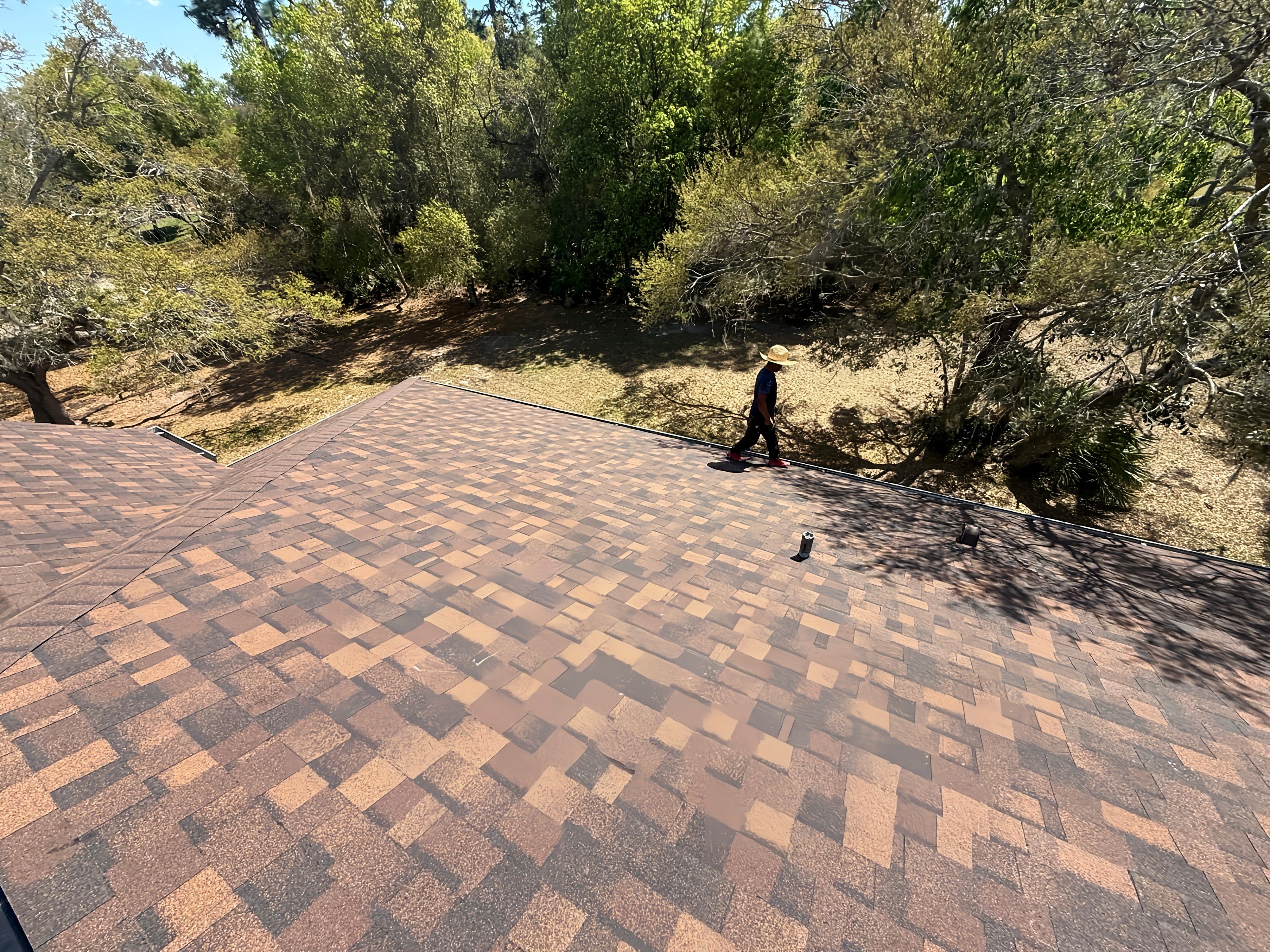
Three places with three different housing stocks
Cocoa, Port St. John and Sharpes share a stretch of the lagoon's west bank, but their houses were built in different decades. A roofer working all three is looking at three kinds of job.
| Place | Homes | Median year built | Largest building decade | Owner-occupied |
|---|---|---|---|---|
| Cocoa (city) | 10,230 | 1975 | 1950s, 22% | 64% |
| Port St. John | 10,351 | 1989 | 1980s, 44% | 94% |
| Sharpes | about 1,500 | 1981 | 1960s, about 25% | about 74% |
Every number in the table is a Census Bureau estimate for the 2020 to 2024 period. Sharpes is small enough that its numbers carry wide margins of error, so treat them as rough.
Cocoa's 1950s and 1960s houses
Nearly half of the homes inside Cocoa's city limits went up before 1970. The 1950s alone account for 22%, the 1960s for 19%, and about 4% are older still. Building picked up again in the 1980s, which added 18%, and the 2010s added 11%.
Houses that old have been re-roofed more than once, and each tear-off can leave nail holes, patches and soft spots in the deck. On a 1950s house the written estimate lists sheathing work as its own line, because the condition of the boards is unknown until the old roof comes off.
Cocoa is also the most mixed of the three places. Detached houses are 62% of its housing, and buildings of 20 or more units hold about 13%. Owners live in 64% of the city's occupied homes, so landlords and associations own a good share of Cocoa's roofs.
Historic Cocoa Village, the city's downtown, keeps some of the town's original commercial buildings, and the city dates its first commercial building to 1881 or 1882. Nearby, the Porcher House, a 1916 Classical Revival house, has been on the National Register since 1986 and is now a historic site. If you own a building there and want to change the roof's color or material, ask the city first whether any design review applies.
Stone Street permits and the fee schedule
The City of Cocoa's Building and Permitting Division is at 65 Stone Street. The counter is staffed on weekdays until 4:30 in the afternoon, and it stops taking payments at 4. Applications, document uploads, fee payments and inspection requests run through Citizenserve, the city's online portal, and reroof is one of the permit types it lists.
The city publishes its fees, which makes an estimate easy to check:
- A $25 application processing fee.
- A residential valuation fee that opens at $75 on the first thousand dollars and adds $4 per thousand beyond it.
- A $75 surcharge on any inspection requested with less than 24 hours' notice.
- Re-inspection fees of $100 after a second failed inspection, $150 after a third and $200 after four or more.
Starting without a permit risks a fee as high as quadruple the usual one. Owner-builders must apply in person with proof of ownership and a driver's license that matches it, and a house owned by a corporation or LLC cannot be permitted that way.
Port St. John's 1980s subdivisions
Port St. John is an unincorporated community between Cocoa and Titusville, with about 25,000 residents. It grew almost all at once. The 1980s produced about 44% of its homes and the 1990s another 27%, while fewer than 2% have gone up since 2010. Detached single-family houses are 93% of the housing, and owners occupy 94% of the homes.
When most of a community was built in the same 20 years, its roofs tend to age together. A house finished in 1985 is likely on at least its second shingle roof, and its neighbors on the same street may come due in the same few years. A repair is the right call for a single leak on a sound roof. Widespread granule loss, curled tabs or several leaks on a roof past mid-life point to a roof replacement. Our repair or replace guide walks through the signs.
The county reroof permit for Port St. John and Sharpes
Because Port St. John, Sharpes and Canaveral Groves are not cities, Brevard County permits their roofs. The county's reroof permit applies to new or repaired roof coverings, skylights among them, and a general contractor filing one lists the roofing sub by name. An owner-builder has to file face to face, as Fla. Stat. 489.103 requires.
The county lists these documents with the application:
- The building permit application, which a licensed contractor filing online does not need
- A subcontractor authorization for each subcontractor
- A supplemental fastener affidavit
- For jobs over $5,000, a Notice of Commencement already recorded with the Clerk
At submittal the county collects $25 for processing and $10 for its program against unlicensed contractors, plus a building code review charge that starts at $75 and climbs $3.25 for every thousand dollars of contract price past the first, or $32.50 for each additional $10,000. State surcharges of 1.5% and 1% are then figured on the county fees.
Manufactured homes in Sharpes
Sharpes stands apart from its neighbors. Close to half of its roughly 1,500 homes are manufactured homes, by the 2020 to 2024 survey, and another 45% or so are detached houses. The county's reroof permit page exempts mobile homes from the permit.
A manufactured home's roof is a different system from a site-built roof, with different materials and rules. Before booking, phone us with the home's year and roof type, and you will get a plain yes or no on whether it is work we do.
Storm records for Cocoa and Port St. John
NWS Melbourne's report on Hurricane Milton in October 2024 put Brevard's peak gusts at 50 to 70 mph across most of the county and as high as 80 mph near the coast. Of the 405 structures Brevard's preliminary assessment listed as affected, 33 had major damage and 111 had minor damage. Gauges around Cocoa caught 5.85 to 6.49 inches of rain. The county's one Milton tornado, an EF-1, came ashore at Cocoa Beach and then crossed the Banana River, per the NWS track summary.
Hurricane Ian in 2022 was a rain event here. Over September 27 to 30, a gauge near Canaveral Groves measured 10.48 inches and one three miles west-northwest of Cocoa measured 10.24. A gauge east of Sharpes recorded 8.41, and a station in Port St. John logged a peak gust of 44 knots, about 51 mph.
Tropical Storm Fay in August 2008 was wetter still on this stretch. NWS Melbourne's preliminary list shows 13.84 inches in Port St. John and 13.48 inches at a gauge 2.6 miles west-northwest of Cocoa, and county officials counted about 1,600 homes in Brevard damaged by flooding.
Hurricane Matthew passed about 25 miles off the Brevard coast on October 7, 2016. On the mainland, the NWS found that most property damage came from falling trees, especially on older buildings and on mobile homes near wooded areas. Some homes took in water through damaged roofs.
Those four storms describe the risk on this stretch of mainland. Wind damage is usually a lifted shingle, a torn ridge cap or a limb through the deck, and the leak shows up in the next rain. Our roof leak repair page covers finding the entry point, and our storm damage guide lists what to photograph first.
Insurance on older Cocoa roofs
The 25% rule bites hardest in Cocoa, where so much of the housing predates the 2007 Florida Building Code. Once repairs on an older roof section pass a quarter of that section within 12 months, the whole section has to come up to current code.
Homes built before 2008 can qualify for My Safe Florida Home help, and most houses in all three places meet that date. After a new roof goes on, a wind mitigation inspection records the features insurers credit.
Ranges for each material are on the roof replacement cost page, drawn from our Orlando-area work. On the coast and the islands, the price waits for the inspection, which shows the deck, the access and the fastening the job needs.
Sources
- Census Reporter, Cocoa city, ACS 2020 to 2024 5-year estimates (housing, year built, tenure, units in structure)
- U.S. Census Bureau, ACS 2020 to 2024 5-year estimates, year structure built (B25034), Cocoa city
- Census Reporter, Port St. John CDP, ACS 2020 to 2024 5-year estimates
- Census Reporter, Sharpes CDP, ACS 2020 to 2024 5-year estimates
- City of Cocoa, Building and Permitting
- Brevard County, Residential Reroof permit
- NWS Melbourne, Hurricane Milton impacts by county (2024)
- NWS Melbourne, Hurricane Milton tornado track and impact information
- NWS Melbourne, Hurricane Milton rainfall observations (2024)
- NWS Melbourne, Hurricane Ian post-tropical cyclone report (2022)
- NWS Melbourne, Hurricane Matthew post-tropical cyclone report (2016)
- City of Cocoa, History and Culture
- National Park Service, Porcher House (NRIS 86000023)
- U.S. Census Bureau, 2020 Florida place codes (incorporated places and CDPs in Brevard County)
- NWS Melbourne, Tropical Storm Fay post-tropical cyclone report (2008)