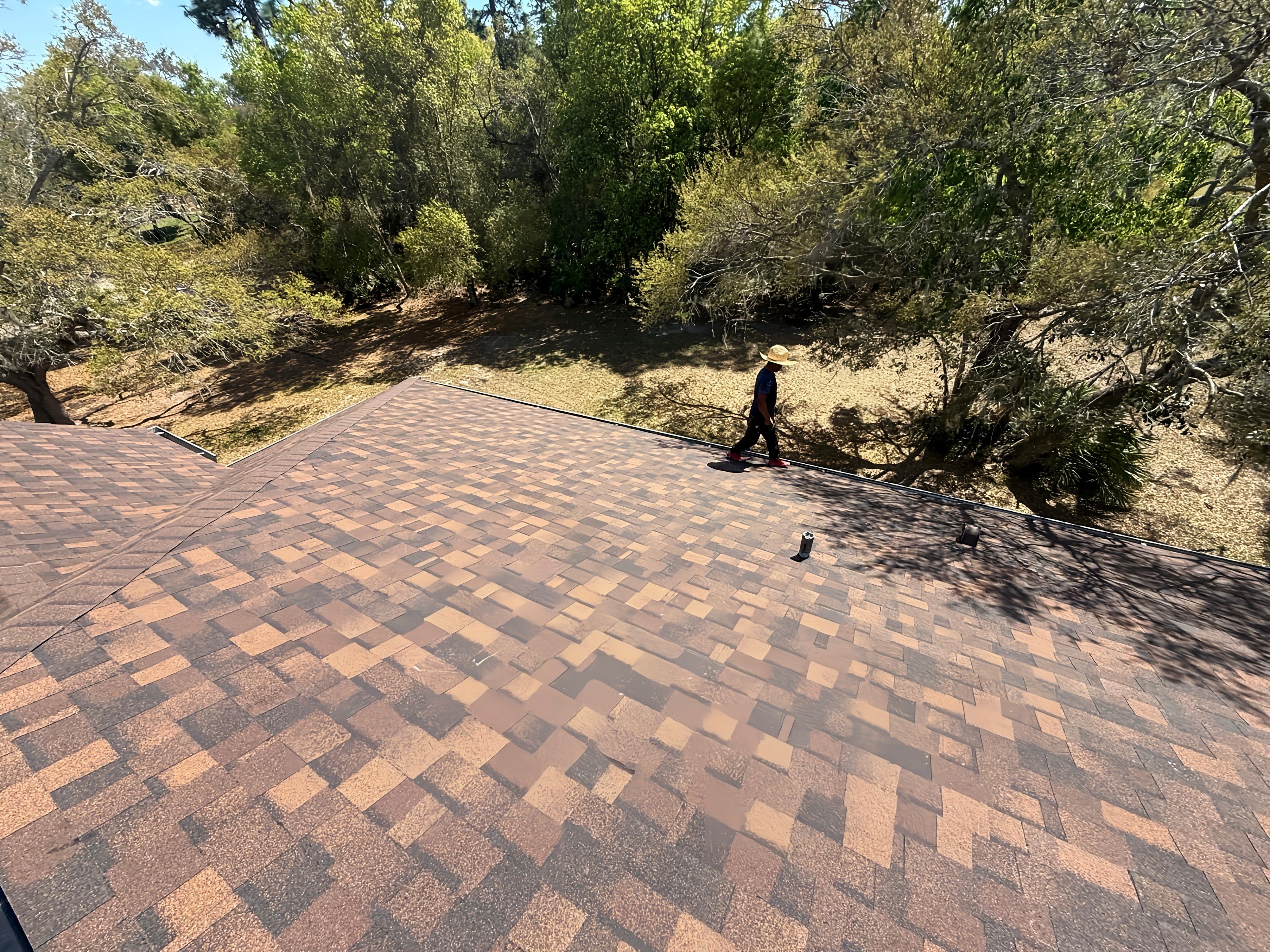
St. Cloud's re-roof rules
The City of St. Cloud Building Department at 1300 9th Street lists reroofing among the jobs that need a permit, and its re-roof checklist holds one rule that changes repair decisions. If the repair is over 20 percent of the roof, the city requires a complete re-roof. Florida's better-known 25% rule sets a higher bar. In St. Cloud, a storm that damages one slope of a small roof can push the job past the city's line. The exception is a roof permitted under the 2007 Florida Building Code or later. Section 553.844(5) exempts those roofs from replacement rules like this one and bars local governments from amending that exemption.
So when we inspect a St. Cloud roof after a storm, we measure the damaged area and show you the percentage in the photo report. If it is close to 20 percent, you know before the quote that the city may want the whole roof done.
The rest of the checklist is straightforward:
- A notarized roofing application and product approvals for the materials.
- A Notice of Commencement, which the city's form asks for at $5,000 or more in materials plus labor, recorded at the Osceola County Courthouse.
- A permit number within three business days of receipt.
- A re-roof affidavit that lets a licensed residential contractor skip the in-progress inspections and call only for the roof final.
New applications go through the city's digital application portal. Permit fees are paid online, and inspections can be requested through the WebPermits portal, the phone line or a text.
City limits and Osceola County
St. Cloud's four residential ZIP codes, 34769, 34771, 34772 and 34773, hold about 106,700 people. The city itself has about 65,100. Roughly 40 percent of the people with a St. Cloud address live in unincorporated Osceola County, in Harmony, Narcoossee Village and along Narcoossee Road.
For those addresses, the city sends applicants to the Osceola County Building and Permitting Office at 1 Courthouse Square in Kissimmee. The county issues many residential roofing permits online or at the counter the same day, and it also requires a Notice of Commencement over $5,000. We check the parcel on the property appraiser's site before filing, as the city advises.
Step by step through a St. Cloud permit
The city's re-roof checklist puts a clock on each stage. Applications that arrive after 3 p.m. count as received the next business day. If a form is missing or filled out wrong, the city emails the applicant within three business days. Once the permit is approved, the contractor gets an email with instructions to pay online, and the permit is issued the business day after payment. When the job passes its final, a certificate of completion can be requested by phone, text or the WebPermits portal, and the city issues it within two business days.
Two rules matter for landlords. On a leased house, the city wants the owner's authorization or an executed contract, so a tenant cannot sign for the roof. The city also requires each applicant to register with it before applying. We send the whole package in one submission so the three-day count starts on the first try.
A Union veterans' colony with a historic core
A state historical marker records that St. Cloud was founded in 1909 as a community for Union veterans of the Civil War. The city incorporated in 1911, and the Grand Army of the Republic hall built in 1914 still stands at 1101 Massachusetts Avenue.
That history left the city an older core around downtown. The Census counts 984 St. Cloud homes built in 1939 or earlier. No permit is issued inside the Historic Preservation District until a certificate of appropriateness is approved. The review covers actions affecting the exterior of every property in the district, follows the Secretary of the Interior's Standards and asks that roof shape stay compatible with contributing buildings. Smaller jobs can go to staff, and larger ones go to the board. We prepare the request with photos and material specs before we file for the permit.
Newer St. Cloud subdivisions
Beyond the old grid, most of St. Cloud is new. The median home was built in 2003. About 57 percent of homes went up in 2000 or later, and 5,570 date from the 2010s alone. Canoe Creek Lakes, Stevens Plantation and Twin Lakes are inside city limits, so their permits go to 9th Street.
The roofs from the early 2000s are now around 20 years old. Owners in those subdivisions may see their insurer ask about roof age at renewal. A roof replacement on those homes comes with a wind mitigation inspection we arrange at no charge.
Housing types and the repair question
Detached houses make up 16,406 of St. Cloud's 22,807 housing units, about 72 percent. The Census also counts 2,317 attached single-family homes, 901 units in two-unit buildings and 1,459 mobile homes. Owners live in 15,350 of the 21,164 occupied homes, about 73 percent.
Each age band leads to a different job. The 984 homes from 1939 or earlier and the 1,494 built from 1940 through 1969 may have plank decking, older roof layers or low-slope porch roofs, and we price those conditions into the estimate after checking the attic. The 7,420 houses from the 1970s through the 1990s have usually been re-roofed at least once, so the date on the last roof permit tells us more than the build year. The 5,463 homes from the 2000s are reaching their first replacement. For the 7,446 built since 2010, a lifted shingle or a cracked pipe boot is a roof repair, and a ceiling stain after a storm calls for roof leak repair. When the whole roof is done, our roof replacement page explains what is included, and the roof cost calculator gives a starting range.
Insurance and an older St. Cloud roof
Insurers ask about roof age at renewal, and St. Cloud's old core and its 2000s subdivisions both draw those questions. Florida law protects a roof under 15 years old from a refusal based on age alone. For an older roof, you can have it inspected before any replacement is required, and five or more years of remaining life keeps age from being the reason for a refusal. The roof age guide also covers Citizens' rules for shingle roofs over 25 years and metal roofs over 50.
Any St. Cloud home more than 20 years old needs a 4-point inspection for a new Citizens policy, which includes every one of the 984 pre-1940 homes. That form's roof section asks for the covering type, the roof's age and when it was last permitted. The wind mitigation form has its own category for hip roofs, so the roof shape of your house can affect the wind part of the premium along with the deck nailing.
Storms across Osceola County
Hurricane Charley's eye passed over Kissimmee at 8:27 p.m. on August 13, 2004. A station in St. Cloud recorded a 62-knot gust, and the National Weather Service confirmed a brief F0 tornado in Harmony on US 192. In 2017, the National Hurricane Center reported about 4,000 structures damaged in Osceola County from Irma. During Ian in 2022, a gauge eight miles east of St. Cloud collected 13.12 inches of rain. In 2024, Milton brought gusts of 55 to 65 mph to the county, with downed trees and power lines.
The February 2014 squall line
On the evening of February 12, 2014, a fast-moving squall line crossed Osceola County. After reviewing photos and radar, the National Weather Service determined that straight-line westerly winds of 60 to 75 mph caused the damage in St. Cloud. About a dozen homes had mostly minor damage to soffits and shingles, and trees, fences and power lines came down. The city's emergency manager reported four homes in the Sweetwater Creek subdivision that lost shingles and awnings, with gutters down and a hole punched in one roof.
A storm like that interacts with the city's 20 percent rule. Wind damage does not have to cover the whole roof to cross that line. On a small house, one stripped slope can exceed a fifth of the roof. We measure the missing area before quoting. If the roof is open, emergency tarping costs $300 to $1,200, with steep or large roofs at the top of that range.
Our storm damage service covers tarping and the photo documentation your insurer will ask for. We have been based in East Orlando since 2004, about 40 minutes north by Narcoossee Road. Schedule a free roof inspection for your St. Cloud home, or call (407) 970-9746.
Sources
- Florida Statutes section 553.844 (2026)
- City of St. Cloud, Permit Information
- City of St. Cloud, Re-Roof permit checklist
- City of St. Cloud, Online Permit Application Submittals
- Census ACS 2020 to 2024 5-year estimates, St. Cloud city (Census Reporter)
- NWS Melbourne, Hurricane Charley survey
- NWS Melbourne, Hurricane Ian rainfall totals
- NWS Melbourne, severe weather event report, February 12, 2014
- National Hurricane Center, Tropical Cyclone Report for Hurricane Irma (2017)
- NWS Melbourne, County Impacts Associated with Milton (2024)
- Florida Historical Marker Program, G.A.R. Memorial Hall, St. Cloud
- Osceola County, Apply for a Building Permit