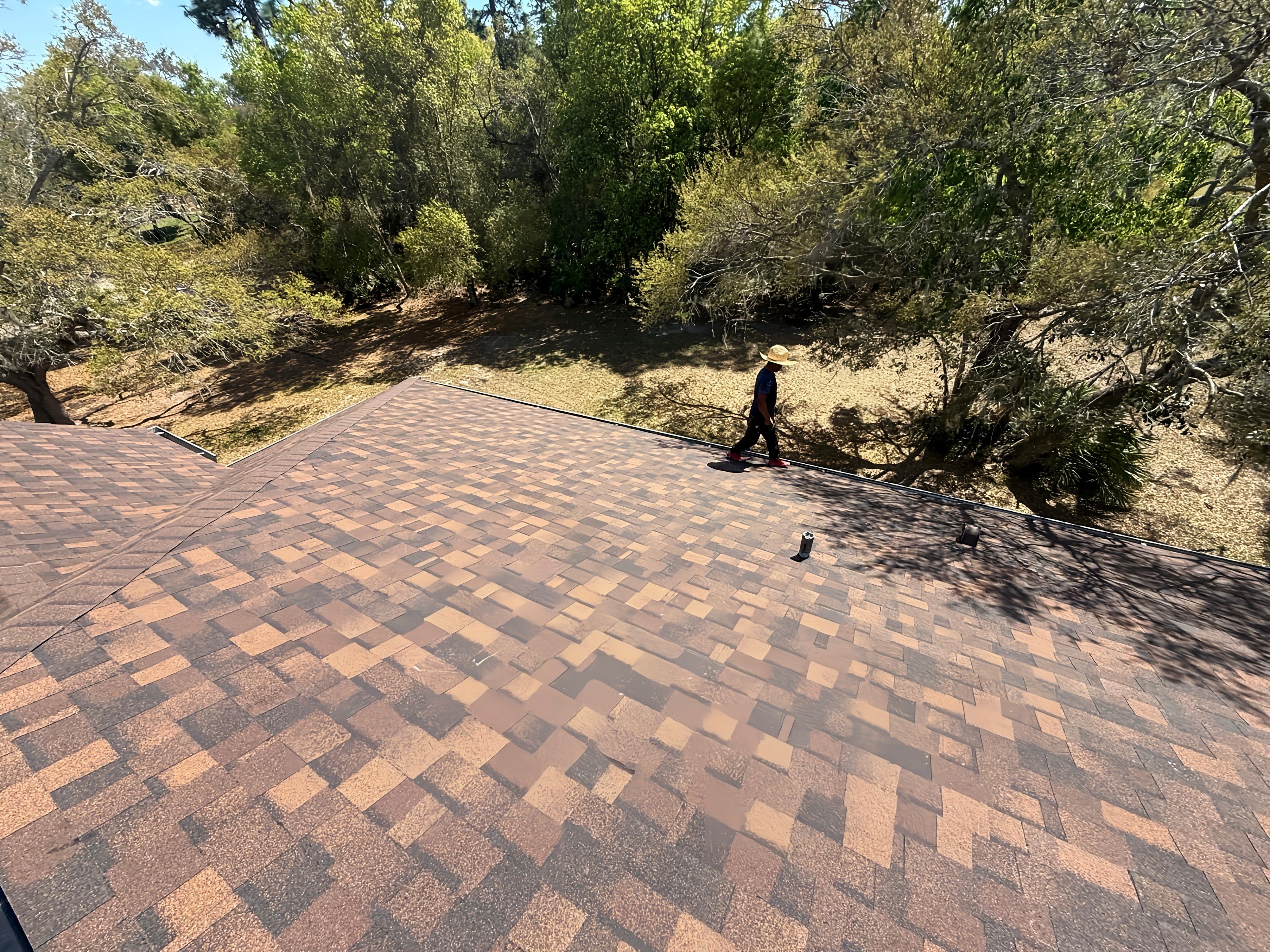
Four local historic districts, each with its own roof rules
The City of Sanford regulates four local historic districts under Schedule S of its Land Development Regulations. They are the Downtown Commercial, Sanford Residential, Sanford Avenue and Georgetown Residential districts. Three of them, the Downtown Commercial, Sanford Residential and Georgetown districts, also appear on the National Register, listed in 1976, 1989 and 2020.
For a roofing job, the city's local rules are what count. In the Downtown Commercial, Sanford Avenue and Sanford Residential districts, the city requires a Certificate of Appropriateness before any exterior work begins, repairs included. Georgetown is narrower. There, a COA is required for demolition and new construction, so a straight re-roof goes to the Building Division for a permit without a historic review step.
Schedule S spells out what a new roof in these districts has to look like. The rules we plan around on every historic job are these:
- An original roof shape and material in good or repairable condition stays.
- Replacement roofing has to resemble the existing or original roof in composition, size, shape and texture.
- Every shingle has to be an architectural profile. Three-tab shingles are not allowed.
- All pitched roof planes on the house must match each other in material, color and texture.
- Dormers, cornices, chimneys, parapets, eaves and exposed rafter tails stay in place and stay visible.
- Metal roofs must be standing seam, stamped metal shingle, full corrugated or 5V crimp, in copper, galvanized, silver, gray or a patina finish.
Repairs follow the same logic. Schedule S allows a roof repair only when the new material matches the existing roof in material, shape, texture, dimension and color. A patch in a shingle that no longer matches the field can fail review, so on older roofs we sometimes recommend replacing a full plane instead of spot repairs.
For the Sanford Residential district specifically, Schedule S names wood shingles, galvanized steel and asphalt shingles as consistent with most house styles there. Gutters must be galvanized steel, wood, copper or painted aluminum, in half-round or low box profiles.
How a historic roof application moves through the city
The city's COA requirements sort applications into minor and major reviews. Roofs and gutters fall on the minor list, along with replacement in the same or like material. Planning staff decide minor applications. Major reviews go to the Historic Preservation Board, which meets on the third Wednesday of each month in the City Commission Chambers at 300 N. Park Avenue, with a filing deadline on the first of the month.
A roof application needs a photo of the whole front of the building, photos of each side the work touches and a description or sample of the new material with the roof color. The city takes COA applications and fees through its Citizenserve portal. A COA does not replace the building permit. The city's own requirements note that both may apply, so we file the COA first and submit the permit once staff signs off.
The city states that staff and the board review only complete applications, so a missing photo or color sample sends the packet back. We photograph every elevation during the free inspection, so the packet is ready when you choose a material.
Sanford's housing stock by decade, per the ACS
Census Bureau estimates for 2020 to 2024 put 27,088 housing units inside Sanford city limits, with a median year built of 1994.
- 1,481 units, about 5 percent, were built in 1939 or earlier.
- 6,508 units, about 24 percent, date from 1940 through 1979.
- 7,800 units, about 29 percent, went up in the 1980s and 1990s.
- 11,299 units, about 42 percent, were built in 2000 or later, and 6,654 of those came in the 2000s alone.
Owners live in 12,947 of the 24,875 occupied homes, about 52 percent. Renters occupy the other 11,928. That near even split means many Sanford roofs belong to landlords, and rental owners often weigh repair against replacement on different terms than someone planning to stay twenty years.
Matching the roof plan to the house's decade
The numbers above describe three different roofing problems inside one city.
Pre-1940 houses. The fifteen hundred or so homes from before 1940 include many wood-frame houses with steep pitches, board decking and attached porches on a shallower slope. These roofs have often been re-covered more than once, so tear-off can reveal several layers and soft or gapped boards. We price decking repair into the estimate instead of surprising you mid-job, and we treat the porch as its own roof section, since its slope often calls for a different material than the main roof.
Mid-century and 1970s homes. Houses from 1940 through 1979 make up about a quarter of the stock. Many are single-story ranches with simple gable or hip roofs. At roughly 45 to 85 years old, nearly all of them have been re-roofed, and the question now is the condition of the replacement roof and the deck under it. If a 1990s re-roof is still on the house, it has outlived the 15 to 22 years a Central Florida shingle roof usually lasts. See how long a roof lasts in Florida for the reasoning.
2000s and newer subdivisions. Sanford's 6,654 homes from 2000 through 2009 still carry roofs between 17 and 26 years old if nobody has replaced them. By the same 15 to 22 year rule, original shingles on many of those homes are due for roof replacement or close to it. Another 3,845 homes went up from 2010 to 2019, and 800 more since 2020. Most of those roofs are still inside their expected life, so the usual calls there are for wind-lifted shingles, pipe boot leaks and flashing, which is roof repair work. Newer neighborhoods often have HOA rules on color and shingle profile, and we prepare that submittal along with the permit. Florida's 25 percent roof rule also matters here, because a large storm repair on an older roof can trigger full replacement.
Lake Monroe's record crest in October 2022
NOAA's river gauge on the St. Johns River near Sanford sets flood stage at 5.5 feet and major flooding at 8 feet. The highest crest in its record is 8.96 feet, on October 9, 2022. That date falls inside FEMA's incident period for Hurricane Ian, which ran from September 23 to November 4, 2022. Under that declaration, DR-4673, FEMA approved Seminole County for its Individuals and Households Program and for Public Assistance.
The gauge's next highest crests are 7.89 feet in September 2008 after Tropical Storm Fay, 7.51 feet in October 2004, 7.23 feet in September 2017 and 7.16 feet in October 2024. Each came during hurricane season, so high water on Lake Monroe tends to arrive in the same weeks that roofs take wind and rain.
River flooding and roof damage are separate claims with separate coverage. When we inspect after a storm, we photograph the roof on its own and keep the report to roof conditions, so an adjuster can see exactly what the wind did. Our guide on what to do after storm damage walks through the order of calls. Water dripping from a ceiling light calls for a tarp before anything else, which is the job of our emergency tarping crew.
Flat roofs behind downtown parapets
Many older commercial buildings in the Downtown Commercial district carry flat or low-slope roofs hidden behind parapet walls. Schedule S lets a flat roof that cannot be seen from the ground use a different material than the rest of the building, but it bars plastic roofing membranes from view of the right of way. Parapets count as a character-defining feature, so they stay.
Most leaks on these buildings start where the membrane turns up the inside of the parapet, at scuppers and around rooftop units. We replace these roofs with TPO or modified bitumen and rebuild the parapet flashing as part of the job. Pricing runs $7 to $13 per square foot. Our flat roofing and commercial roofing pages cover materials and scheduling around open businesses.
Getting started on a Sanford roof
Addresses inside the city get their roof permit from the City of Sanford, and unincorporated addresses with a Sanford mailing address go through Seminole County. We check the parcel, its historic district status and any HOA rules before we quote. Every replacement includes a free wind mitigation inspection, which can lower your insurance premium. Book a free roof inspection and we will send a photo report of what we find.
Sources
- City of Sanford, Historic Preservation (local and National Register districts, COA requirement, Citizenserve filing)
- City of Sanford, Requirements for Certificate of Appropriateness Application
- City of Sanford Land Development Regulations, Schedule S, Historic Preservation District (Ord. 2023-4729 and 2023-4730)
- U.S. Census Bureau, ACS 2020 to 2024 5-year estimates, tables B25034, B25035, B25001 and B25003, Sanford city, Florida
- NOAA National Water Prediction Service, St. Johns River near Sanford (SNFF1), flood categories and historic crests
- FEMA OpenFEMA disaster declarations, DR-4673-FL Hurricane Ian, Seminole County designation