Melbourne's housing, decade by decade
The Census Bureau's five-year survey for 2020 through 2024 puts Melbourne at about 41,200 housing units, with a median build year of 1985. The age spread is wide, and it decides most roofing jobs here:
- Fewer than 1,000 homes predate 1950.
- About 10,300, a quarter of the city, went up from 1950 through 1969.
- About 4,900 date from the 1970s.
- About 9,700 came in the 1980s alone, the largest single decade.
- About 6,000 came in the 1990s, and about 9,400 more since 2000.
Owners live in about 60% of the occupied homes, and renters in the rest. A little over half the housing is detached single-family homes. Apartment buildings of five or more units hold about a quarter. About 1,700 units are mobile or manufactured homes, and their roofs follow different rules than a site-built house, so ask us before booking whether we can help with yours.
Roofs on Melbourne's postwar houses
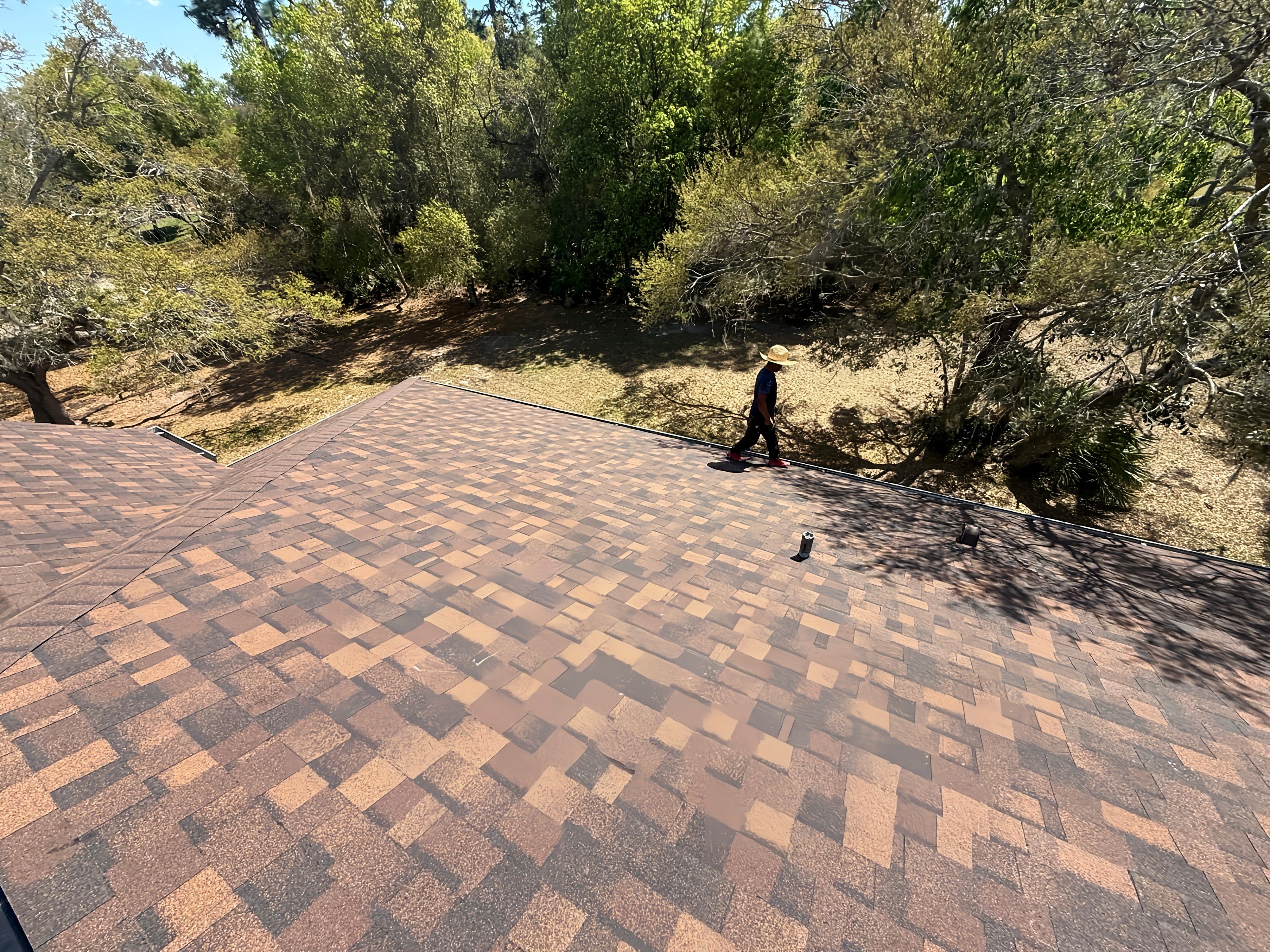
The homes from Melbourne's 1950s and 1960s growth are 55 to 75 years old, so nearly all of them have had at least one new roof since they were built. Some have had two, and a few still carry two layers of shingles.
On these houses we look at the deck as closely as the shingles. Decking that old can have soft spots at the eaves and around old vent openings, and a low-slope porch or room added later and tied into the main roof is a common leak point. When the porch roof is too flat for shingles, it gets a membrane, which our flat roofing page describes. The estimate lists decking repair as a separate line, since the amount of bad wood is only known once the old roof comes off.
The 1980s tract homes
Close to 9,700 Melbourne homes came from the 1980s, and they make up the largest group of roofs in the city. They predate the statewide Florida Building Code, and the roofs on them now are usually a second or later covering.
Three things are worth checking on a home of this age:
- Deck attachment. Brevard County, Rockledge and West Melbourne all ask for a fastener or nail-off affidavit with a reroof, and we check and fasten the deck on every job. A wind mitigation inspection afterward records it for the insurer.
- Ventilation. A roof replacement is the cheapest time to check intake and exhaust venting against the attic ventilation rules.
- Old repairs. Earlier patches with mismatched shingles show where the roof has failed before.
Pre-2007 roofs like these are the target of the 25% roof rule. Repairing more than a quarter of one in a year can require the entire roof to meet current code, so a large storm repair on a 1980s house often becomes a replacement conversation.
Building Section rules inside Melbourne
Every address inside Melbourne's city limits gets its permit from the Building Section at City Hall on East Strawbridge Avenue. Reroofing is one of the projects its FAQ names as needing a permit, and every application is filed online through EnerGov.
Some details from the city's pages that shape a reroof schedule:
- A residential permit that needs only one review averages 5 to 7 working days.
- The permit holder is responsible for having every required inspection done before the next phase.
- A skipped inspection is recorded as failed and costs a reinspection fee.
- An issued permit has 180 days to reach a passed inspection.
The permit counter is open weekdays from 7:30 a.m. to 4 p.m., and most field inspectors take calls from 7:45 a.m. Each permit's list of required inspections shows up in the contractor's portal account.
Pulling a Melbourne permit as the owner
Some owners want to pull the permit themselves. The city's FAQ allows an owner-builder permit when the property is owned by an individual and will not be sold or leased for a year. Commercial owner-builder work has its own cap of $75,000 in construction value.
The owner-builder then carries the contractor's duties, including booking each inspection in the right order. Most homeowners hiring a licensed roofer leave the permit with the roofer, so the person doing the work is the one the inspector deals with.
Shingle or metal on a Melbourne house
Whether metal is worth the extra cost depends on how long you plan to stay and how close you are to salt water.
- Architectural shingles cost less up front and are the usual choice on 1980s and 1990s tract homes, where an HOA may also expect them.
- Standing seam metal costs more but sheds rain fast and lasts longer. Near the lagoon or the beach, the coating and fasteners have to be chosen for salt air.
- Tile shows up on some newer homes. Replacing it is a different job, covered on our tile roofing page.
Our comparison of shingle, metal and tile roofs in Florida lays out cost and lifespan side by side.
West Melbourne's separate building department
West Melbourne is its own city, with a building department on Minton Road that issues its own permits. The Census numbers make it a different market from Melbourne. Half its homes are newer than 2003, and roughly 7,000 of its 11,700 housing units went up after 1999. Owners occupy about 73% of its homes. It also has about 400 mobile homes.
The West Melbourne Building Department takes permit applications through a BS&A online portal. For reroofs, its inspectors do the dry-in inspection, and the city expects a roof nail-off affidavit on the job site. An owner-builder cannot use that affidavit and has the nail-off inspected instead. Inspection calls in before the 3 p.m. cutoff land on the next business day, and field inspections run from early morning until 2:30 p.m.
Most West Melbourne roofs from the 2000s are now 20 years old or more. Original shingles of that age are at or near the end of their service life, and roof repair stops making sense once leaks show up on more than one slope.
Eau Gallie, a city until 1969
Eau Gallie was a separate city until 1969, when voters approved merging it with Melbourne. Its old downtown is now the Eau Gallie Arts District, a designated Florida Main Street program.
The Olde Eau Gallie Riverfront redevelopment area has its own Historic and Architectural Review Board. The city says exterior changes to commercial buildings and signs in that area need the board's approval first. That covers commercial buildings, not houses, but a shop or office there that wants a new roof color or material should expect the review. Flat and low-slope roofs on older commercial buildings are a commercial roofing job, and we can look at those too.
Jeanne, Frances and the 2004 season
Melbourne's 2004 storm record comes from the National Weather Service office in the city. During Hurricane Jeanne on September 26, 2004, the office recorded a peak wind of 79 knots, about 91 mph. The airport's automated station logged 68 knots before its record cut out, and the NWS notes that its data understates the true winds.
The NWS preliminary report counted 14,207 Brevard homes damaged and 892 destroyed by Jeanne, with an early damage estimate of $320.4 million. Jeanne came three weeks after Hurricane Frances had hit the same stretch of coast, so many roofs were struck twice before they could be repaired.
Wind gets under a roof's edges first. On a replacement, we pay attention to the drip edge, the starter course and the ridge, the parts that let go first in a hurricane.
Getting a roof started in Melbourne or West Melbourne
Plan on about 80 minutes for the trip from our East Orlando office to Melbourne. The free inspection covers every slope, the attic where it can be reached, and the permit office for your parcel. The written estimate follows. You can book a free roof inspection online.
Sources
- U.S. Census Bureau, ACS 2020 to 2024 5-year estimates via Census Reporter, Melbourne and West Melbourne cities, tables B25034, B25035, B25003 and B25024
- City of Melbourne, Building Section (EnerGov portal, inspections, hours)
- City of Melbourne, Building Section Frequently Asked Questions
- City of Melbourne, EnerGov Instructional Videos
- City of West Melbourne, Building Department
- City of Melbourne, Olde Eau Gallie Riverfront CRA (1969 merger, Historic and Architectural Review Board)
- Brevard County Planning and Development, Residential Reroof permit (supplemental fastener affidavit)
- City of Rockledge, Residential Permit Requirements (deck nailing affidavit)
- National Weather Service Melbourne, Hurricane Jeanne preliminary summary report for east central Florida (2004)