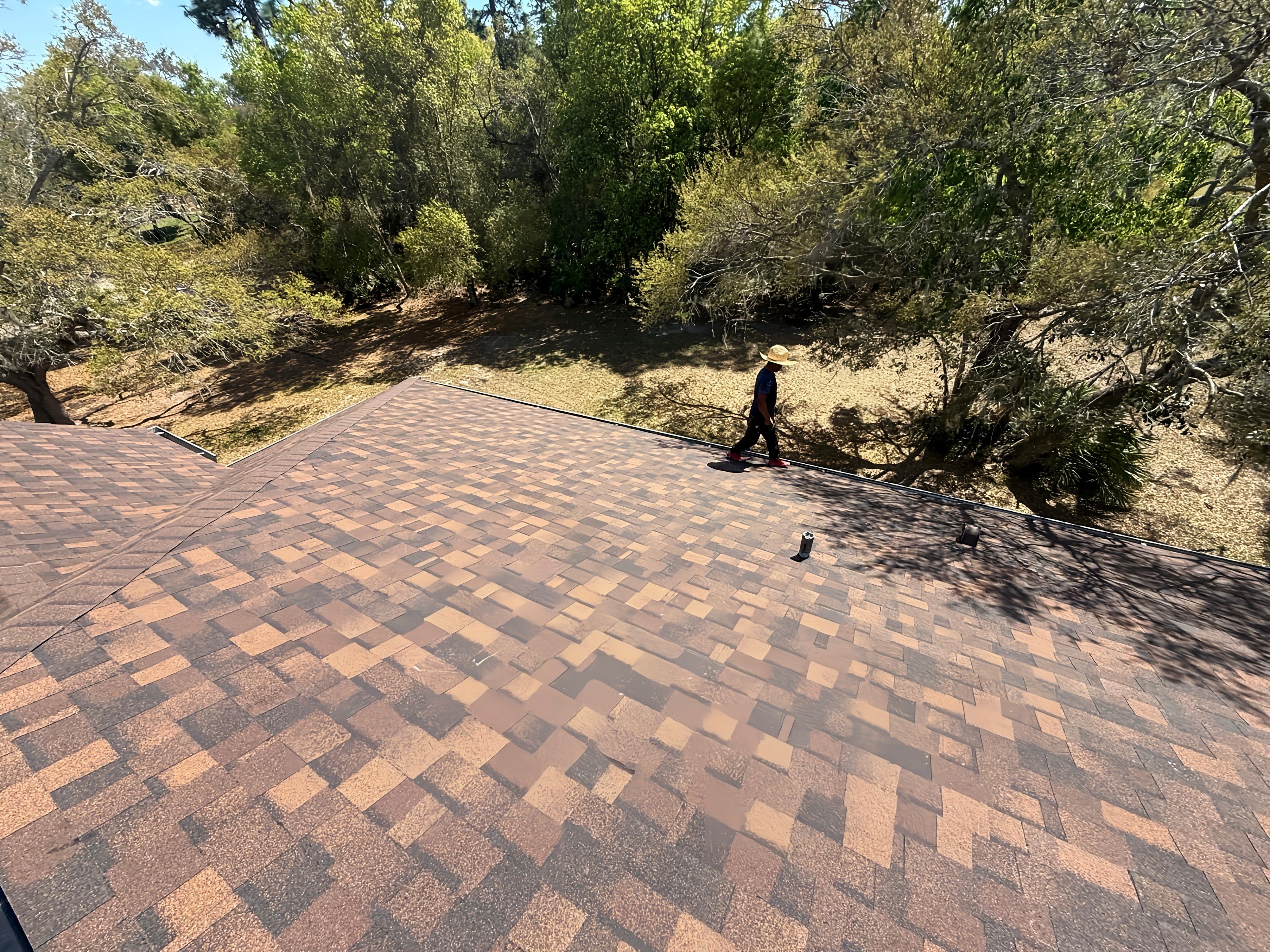
1960s beach houses and large multi-unit buildings
Cocoa Beach had 11,377 residents and 9,052 housing units in the Census Bureau's American Community Survey estimates for 2020 through 2024. Most of the housing is old for Florida. A quarter of it was built in the 1960s, another quarter in the 1970s, and a tenth in the 1950s. Only about 8% dates from 2000 or later.
Two building types dominate. Buildings with 20 or more units hold about 40% of all housing, and detached single-family homes account for 29%. Most of the rest is in buildings of 2 to 19 units.
A large share of those units sit empty much of the year. The survey counts 2,242 homes held for seasonal, recreational or occasional use, roughly one in four homes in the city. For a part-time owner, a slow leak can run for weeks before anyone sees a ceiling stain, which is the main argument for an inspection before hurricane season and after any named storm.
The state's coastal line on oceanfront lots
Florida sets a Coastal Construction Control Line on its sandy beaches, and Brevard County's line was adopted by state rule effective December 4, 1986. Seaward of that line, the Department of Environmental Protection applies stricter siting and design rules, because storm forces are greater there. DEP's Map Direct tool shows where the line falls on any parcel.
A roof job usually stays outside the state permit. Section 161.053 of the Florida Statutes exempts modification, maintenance or repair of an existing structure inside the limits of its existing foundation, as long as the work does not add to or alter that foundation. A re-roof that keeps the same footprint fits that description.
The exemption has edges. It does not cover seawalls, and it does not cover additions or enclosures built below the first dwelling floor. The statute also names a new roof overhang that extends no more than four feet beyond the existing foundation as an example of a minor activity DEP may exempt. If a project changes the building's footprint, we check with DEP before quoting the work.
Permits inside Cocoa Beach
The City of Cocoa Beach runs its own Building Division out of 2 S. Orlando Avenue. It accepts building permit applications through the city's OpenGov portal and inspects completed work against the building code.
The city makes one point plainly. Property owners are ultimately responsible for obtaining building permits, not the contractor. A licensed roofer pulls the permit as part of the job, but the owner carries the risk if nobody does. Ask to see the issued permit before the tear-off starts, and keep a copy with the final inspection.
Cape Canaveral's building rules
Cape Canaveral, just north of Cocoa Beach, is a separate city with its own Building Division and permits searchable through BS&A Online. Its housing is younger, with a median year built of 1985, and denser. Nearly half its 9,245 units sit in buildings of 10 or more units, and about 7% are mobile homes.
Two Cape Canaveral details come up on roof jobs. A roof repair is exempt from permitting only when it uses less than one square of material, which the city counts as 100 square feet for the entire roof per year. The city's form library also includes an inspection affidavit, a roof deck refastening statement that the contractor signs.
October 9, 2024, street by street
The tornado that crossed Cocoa Beach during Hurricane Milton started as a waterspout near the Royale Towers condominiums east of A1A at 5:53 p.m. It damaged the roofs of storage units and garages on that property first. Crossing A1A, winds estimated at 90 to 95 mph removed a large portion of a bank's roof.
From there it moved into a residential neighborhood. The NWS survey lists partial roof loss, broken windows and downed trees along Bimini Road, St. Croix Avenue and South Banana River Boulevard, from winds of 80 to 90 mph. It then went back over the Banana River as a waterspout. The survey rated it EF-1, with a path up to 250 yards wide.
The Milton report also logged a low pressure of 977.5 millibars at the Cocoa Beach Club weather station. A tornado path is narrow, and two houses on one street can see very different damage. An inspection that photographs each slope shows whether yours took any.
Metal on a lot within sight of the ocean
Standing seam metal roofing appeals to beach owners because it sheds wind-driven rain well and has few exposed fasteners. The coastal catch is corrosion, and the panel warranty shows it. McElroy Metal's limited warranty on painted Galvalume steel is null and void for material subjected to salt spray or installed within 1,500 feet of a salt water environment. That rules out that product for oceanfront and riverfront lots alike.
Aluminum panels are one alternative to price out near salt water. The fasteners, clips and flashing need to match the panel metal, because contact between dissimilar metals is a corrosion problem of its own that warranties exclude. Our metal roof cost guide covers how material choice affects the price.
Flat roofs on condos and small buildings
Many condominium and apartment buildings carry flat or low-slope roofs. Where the declaration treats the roof as shared property, the board decides who roofs it. A membrane roof on one of these buildings is a different scope from a house: parapet flashing, roof drains and rooftop equipment curbs all need attention. Our flat roofing page covers TPO and modified bitumen.
A roof check for owners who are away
With so many Cocoa Beach units held for seasonal or occasional use, plenty of Cocoa Beach roofs go months without anyone inside to notice a drip. A leak that starts in August can show up in November as a sagging ceiling and a mold smell. We suggest two visits a year for an owner who is away, one before hurricane season and one after the last named storm.
On a beach house, the inspection follows the places salt and wind work on first. That means the drip edge and any exposed nail heads along the eaves, flashing at walls and chimneys, vent boots, and the fasteners on any metal trim. We also check the attic for daylight and stains, because a stain on the decking shows a leak long before the ceiling does. The photo report lets an owner who is out of town see the same thing we saw on the roof.
Insurance inspections people ask for in Cocoa Beach
Searches for a roof inspector in Cocoa Beach usually mean one of three forms. A four-point inspection is common for older homes at a sale or a new policy. A wind mitigation inspection records features that can earn premium credits. A roof certification states the roof's remaining life. Our guide to wind mitigation, four-point and roof certification explains which one fits your situation.
What we provide is a free roof inspection with a photo report, the same whether you hire us or not. Call (407) 970-9746 to set one up. Because so many Cocoa Beach houses date from the 1960s and 1970s, the 25% roof rule guide is also worth reading before you decide between a repair and a new roof.
What a Cocoa Beach re-roof costs
Our roof replacement cost page lists current ranges by material. As a reference point, architectural shingles come to about $450 to $750 per roofing square, and standing seam metal to about $1,000 to $1,600 per square. On the barrier island the final number is set after the inspection. Aluminum panels, coastal-grade fasteners, deck repairs on a 60-year-old house and any coastal control line questions can each move the price, so the written estimate lists them one by one.
Sources
- U.S. Census Bureau ACS 2020 to 2024 5-year estimates via Census Reporter, Cocoa Beach city (year built B25034 and B25035, units in structure B25024, tenure B25003, vacancy B25004)
- U.S. Census Bureau ACS 2020 to 2024 5-year estimates via Census Reporter, Cape Canaveral city
- Florida Statutes, Section 161.053, coastal construction and excavation (2025)
- Florida Administrative Code, Rule 62B-26.017, Description of the Brevard County Coastal Construction Control Line (effective December 4, 1986)
- Florida Department of Environmental Protection, Coastal Construction Control Line Program
- City of Cocoa Beach, Building Division
- City of Cape Canaveral, Building FAQ (permit exemptions)
- City of Cape Canaveral, Building Documents (inspection affidavit for roof deck refastening)
- NWS Melbourne, damage survey for the Brevard County tornado of October 9, 2024, Update 2 (public information statement, archived by Iowa Environmental Mesonet)
- NWS Melbourne, Hurricane Milton post-tropical cyclone report (2024)
- McElroy Metal, limited warranty for Fluropon PVDF coated Galvalume panels (MM613-GM, rev. 08/23)