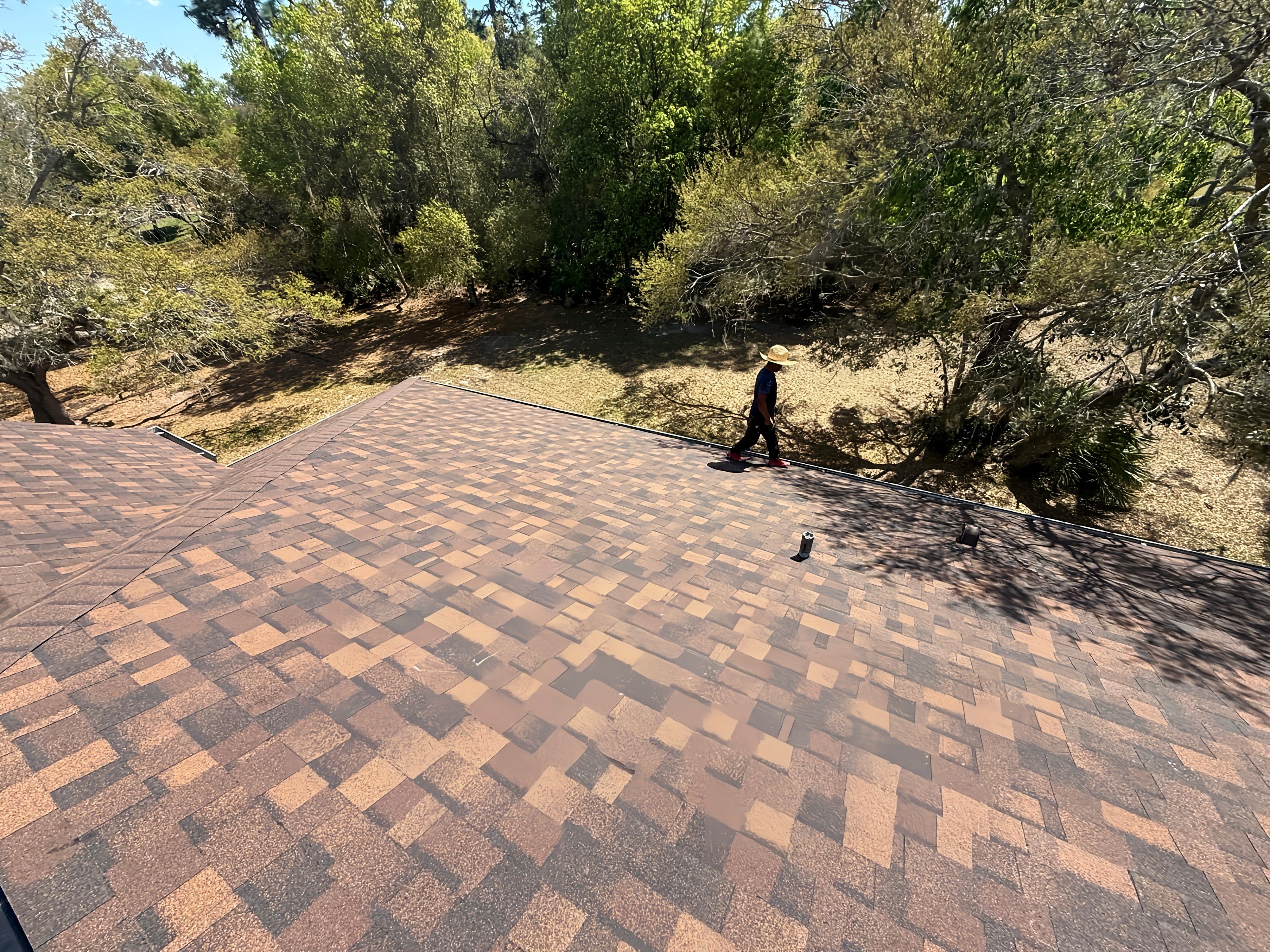
Shade, leaves and limbs
Drive down almost any street near Lake Maitland or Lake Lily and the roofs spend most of the day in shade. That shade costs shingles years. Live oak leaves come down through spring, gather in valleys and behind chimneys, and hold water against the roof long after a storm. Granules wear off faster where the debris sits, and the decking under a wet valley goes soft.
Limbs do the rest. A branch resting on the roof, or swinging a few feet above it, scrubs a path of granules off the shingles every time the wind picks up. In a hurricane the same branch can snap and land on the ridge. On a Maitland tear-off we often find the worst decking along the eaves and in valleys under the heaviest canopy, while the open slope on the far side of the house is still sound.
So the fix starts on the ground. Before we price a replacement, we note which limbs touch or hang over the roof and where debris collects. If the tree work happens first, the new roof starts clean and the crew isn't working around a limb that will hit it next season.
Material matters under a canopy too:
- Standing seam metal. Leaves slide off the smooth panels faster than off textured shingles, and there are no granules to scrub away.
- Concrete tile. It holds debris in its curves and in the gaps at the hips.
- Architectural shingles. Still the usual choice for Maitland ranch houses, and they hold up under oaks when the valleys and gutters get cleared twice a year.
We go through each option during the inspection, standing where you can see the trees.
The tree permit comes before the roof permit
Maitland handles vegetation removal permits through Arbor Care, part of its Public Works department. The submittal checklist asks for a site plan showing where the trees to be removed stand, with their species and size. It also calls for a stake-out inspection before any removal or clearing, with the trees that stay tagged and barricaded. The city lists the inspection line as (407) 539-6258.
State law makes one exception. Under section 163.045 of the Florida Statutes, an owner of a residential lot who holds an assessment from an ISA certified arborist or a Florida licensed landscape architect showing that a tree is an unacceptable risk to people or property needs no local permit, application, fee or mitigation to prune, trim or remove it. The city also can't require replanting. A limb over a bedroom may qualify, but the arborist makes that call, not the roofer.
We don't cut trees. We point out which limbs threaten the roof and leave the permit and the cutting to you and a tree company. When a tree job and a re-roof fall in the same month, we schedule the roof after the tree crew is gone, so no new shingles take a dropped limb.
Ranch houses from the 1950s to the 1970s
The 2020 to 2024 ACS 5-year estimates count about 10,017 housing units in Maitland, with a median year built of 1996. That median blends two very different groups.
About 3,429 units, roughly 34 percent, went up from 1950 through 1979, including about 1,544 from the 1960s alone. At the other end, about 2,972 units, close to 30 percent, date from 2010 or later. Fewer than 250 are older than 1950.
Renters outnumber owners. Of about 8,972 occupied units, about 3,988, or 44 percent, are owner-occupied. These are survey estimates with margins of error, so treat them as a rough picture.
For roofing, the older group matters most. Shingle roofs here usually last about 15 to 22 years, so a house from 1965 has likely been re-roofed two or three times, and each tear-off was a chance for the decking to get patched or missed. Many of these houses also have a porch, carport or family room added later under a low-slope roof, and the joint where that addition meets the original roof is a common leak.
The newer group has its own clock. A shingle roof on a house finished in 2010 is about 16 years old now, already inside that 15 to 22 year range. Our guide to roof lifespan in Florida covers what shortens it.
Permits at Independence Lane
Permits for addresses inside city limits go through Maitland's Community Development Department at 1776 Independence Lane. Applications are filed through the city's online permitting system, and permit specialists check each one for completeness before it moves on.
The material sets the timeline. The city lists repair or replacement of asphalt shingle roofing on single-family and duplex homes as an over-the-counter permit. Barrel tile and metal roofs don't qualify. They go to plan review, which the city says can take up to 30 days depending on workload. If you plan to move from shingles to standing seam metal, build that review into your schedule.
State lien law adds a step. Section 713.135 requires the recorded Notice of Commencement to be on file with the permit office before the first inspection whenever the direct contract tops $5,000. Nearly every full re-roof does. We prepare the notice, file the permit and meet the inspector. The Orange County permit guide covers homes with a Maitland mailing address that sit outside city limits.
Storm gusts recorded near Maitland
The National Weather Service office in Melbourne writes a report after each storm that touches Orange County. Three recent ones show what Maitland roofs have been through.
- Irma, 2017. The storm crossed Central Florida on the night of September 10 into September 11. Orlando Executive Airport, a few miles south of Maitland, recorded a peak gust of 68 knots, about 78 mph.
- Ian, 2022. On September 29, a WeatherSTEM station in Maitland logged a peak gust of 50 knots, about 58 mph. Ian's bigger toll in Orange County was water, with nearly $161 million in property damage the report blames on widespread flooding.
- Milton, 2024. Gusts across Orange County peaked between 55 and 75 mph and hit 87 mph in spots, with scattered downed trees and power lines. The county's preliminary damage count listed 188 structures affected, 79 with minor damage and 32 with major damage.
The Ian and Milton reports share a warning. Each Orange County summary records a man who died in a fall while clearing storm debris from his roof, off a ladder after Ian and off the roof itself after Milton. If a limb lands on your roof, stay on the ground and call us. Our storm damage guide explains what to photograph for your insurer, and our emergency tarping crew covers active leaks first.
Repair or replace on a 1960s Maitland ranch
A leak on an older ranch doesn't always mean a new roof. The usual culprits are a cracked pipe boot, chimney flashing that has pulled loose, or the seam where a low-slope addition meets the main roof. Those roof repairs usually cost $350 to $1,500. Larger fixes, such as rebuilding a rotted valley, run $1,500 to $5,000.
A new roof is the better call when the shingles are brittle across several slopes, the decking flexes in more than one spot, or repairs keep landing on the same roof. Florida's 25 percent rule can also turn a large repair into a full re-roof. Our repair versus replacement guide walks through the math.
A full roof replacement on a Maitland ranch in architectural shingles usually runs $12,000 to $22,000. Metal runs $26,000 to $48,000 and concrete tile $28,000 to $50,000. See roof replacement cost for what moves the number. Under oaks, plan on seamless gutters at $9 to $16 per linear foot, and plan to clean them.
Every job starts with a free roof inspection and a photo report. After a replacement, we arrange a free wind mitigation inspection for you to send your insurer.
Sources
- U.S. Census Bureau, ACS 2020 to 2024 5-year estimates, Maitland city, Florida, tables B25001, B25003, B25034 and B25035 (via Census Reporter)
- City of Maitland, How to Apply for a Permit
- City of Maitland, Vegetation Removal Permit Submittal Checklist
- City of Maitland, Arbor Care
- Florida Statutes, section 713.135, Notice of commencement and applicability of lien
- Florida Statutes, section 163.045, Tree pruning, trimming, or removal on residential property
- National Weather Service Melbourne, Post Tropical Cyclone Reports (Irma 2017, Ian 2022, Milton 2024)