A city built mostly between 1970 and 1999
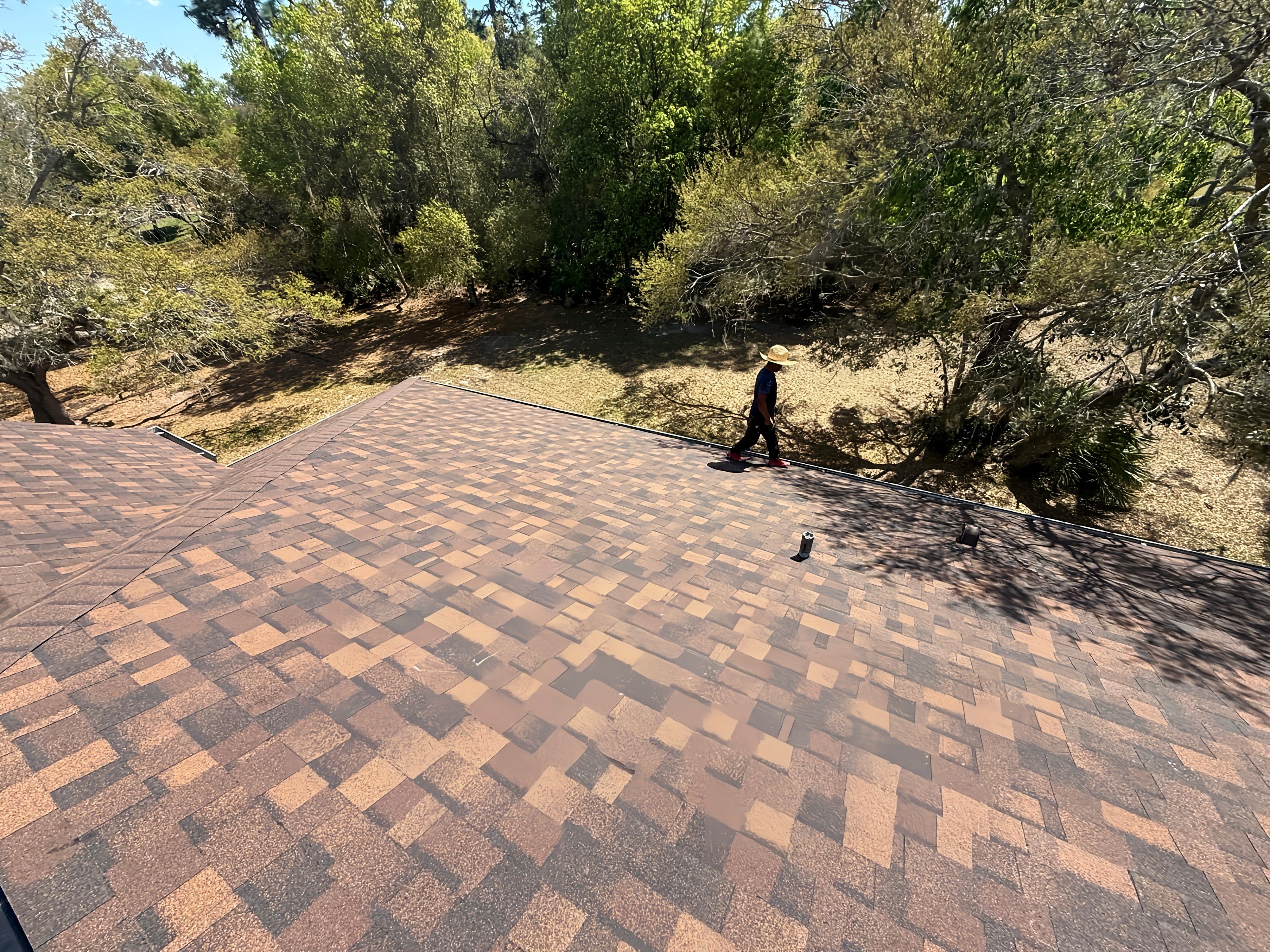
Winter Springs sits on the south shore of Lake Jesup, with Oviedo to the east and Longwood to the west. Tuscawilla, with its golf course and wooded streets, and Oak Forest are its largest neighborhoods. Most homes in both are one or two stories with shingle roofs.
Census Bureau estimates covering 2020 to 2024 put 16,020 housing units in Winter Springs. The median one was built in 1989. About 2,980 units date to the 1970s, 4,810 to the 1980s and 3,415 to the 1990s. That puts roughly 70 percent of the city's homes in a 30-year window. Only about a quarter were built in 2000 or later. The same estimates show about 76 percent of occupied homes are lived in by their owners.
Those years tell you where a roof stands. Most shingle roofs here last 15 to 22 years. A house finished in 1989 likely got its first replacement between 2004 and 2011, and that second roof is now 15 to 20 years old. A house from the late 1970s may already be on its third. Each tear-off leaves another set of nail holes in the plywood, so decking on these homes deserves a close look before a new roof goes on.
Homes from the 1970s and 1980s were also built to older codes than today's Florida Building Code. Their roof decks may be fastened with fewer nails than current rules call for, and some attics have only a few small vents. Poor airflow cooks shingles from below and shortens each roof's life.
When we replace a roof of that age, we check how the decking is fastened and bring it up to the code in force at permit time, replace soft sheets, and add ridge or off-ridge venting where the attic needs it. Those steps are part of why a re-roof on an older house costs more than the same square footage on a newer one.
Our guide on how long a roof lasts in Florida explains why the range is so wide.
Ian's rain on the Lake Jesup shore
Hurricane Ian hit Seminole County in 2022. The National Weather Service office in Melbourne collected storm totals from volunteer gauges across the region. A gauge 0.6 miles south of Winter Springs recorded 15.56 inches. One 2.3 miles east recorded 14.97 inches, and one 1.8 miles south-southeast recorded 12.63 inches. Seminole County's emergency management office says Ian brought more than 16 inches of rain to the county and became its worst flooding event since Tropical Storm Fay in 2008, with more than 260 water rescues.
Most of that water never touched a roof deck, but a soaking that long tests every weak point. Water runs under shingle tabs that have lost their seal. It gets past pipe boots with cracked rubber collars and behind step flashing where a wall meets the roof. A leak like that can wet the insulation for weeks before a stain reaches the ceiling.
The county also notes that Hurricane Milton in 2024 threatened major flooding even though local wind impacts were limited. A wet storm with little wind can still leave a roof leaking. If a stain appeared after either storm and nobody traced it, the source may still be open. Our storm damage checklist covers what to photograph before you call your insurer.
Wind that crosses open water first
Lake Jesup lies directly north of the city. Wind blowing across the lake meets no trees or buildings until it reaches the first rows of homes on shore, so those roofs take the full gust. Seminole County's records describe Hurricane Irma in 2017 as bringing catastrophic winds to the county, and they put Hurricane Charley's 2004 local damage at more than $36 million.
Wind damage on a shingle roof usually starts at the edges. Air gets under the first course at the eave or rake, breaks the seal strips and peels shingles back toward the ridge. Older ridge caps crack and come off in one storm. On homes facing the lake we check those edges, the ridge and the seal on each tab before anything else.
A replacement brings the roof up to the current Florida Building Code for underlayment, nailing and edge metal. The free wind mitigation inspection we include with every replacement records those details on the form insurers use. If you qualify, the My Safe Florida Home program may help pay for wind upgrades.
Oaks, pines and the city arbor code
Winter Springs protects its trees by ordinance. Chapter 5 of the city code requires a permit and a fee to remove any tree 4 inches or more in trunk diameter. On a single-family lot the fee is $25 for the first tree and $10 for each tree after that. Trees that are dead, diseased or a clear hazard to a structure or people are exempt, and the city charges nothing to remove a dead or diseased tree.
That canopy is part of why people buy here, and it is hard on roofs. Shade keeps north slopes damp, which feeds the black algae streaks common on older shingles. Pine needles and oak leaves pile up in valleys and behind chimneys, where they hold water against the shingles. Limbs that rub the roof in the wind scrape off the granules that protect the asphalt. A large limb over the house is also the most likely thing to punch a hole in it during a hurricane.
Before a re-roof, have a tree service cut limbs back from the roof line so the new shingles start clean. If a tree needs to come down, check whether it falls under the hazard exemption or needs an arbor permit first. Gutters do the rest. New seamless aluminum gutters run $9 to $16 per linear foot, and on a heavily shaded lot guards save a lot of ladder trips.
Filing with the Building Division on State Road 434
The City of Winter Springs Building Division works out of 1126 East State Road 434. Its staff reviews plans, issues permits and performs inspections for homes inside city limits. We file online through the Civic Access Portal, though the city also posts paper permit forms. After filing, we schedule the inspections and close the permit when the job passes.
Some homes with a Winter Springs mailing address sit outside city limits. Those are unincorporated Seminole County and are permitted by the county, so we confirm the jurisdiction before filing.
Florida adds a step for larger jobs. Under section 713.135, any direct contract above $5,000 needs a recorded Notice of Commencement, and that takes in every full re-roof. We draw it up for your signature.
Most subdivisions in town have an HOA, and each community writes its own rules on shingle color and profile. We assemble the samples and spec sheets for the review committee and wait for written approval before the permit goes in.
Repair now or replace now
Not every call ends in a new roof. A cracked pipe boot, a few tabs lifted by a summer storm, or a gutter pulled loose under wet leaves are small jobs. These repairs usually run $350 to $1,500. Larger fixes, like cutting out rotted decking along a shaded eave, run $1,500 to $5,000. If a storm has opened the roof, a tarp costs $300 to $1,200 and keeps water out until the repair is done.
On a 1980s house with a second roof near 20 years old, the math changes. Repairs keep coming, and insurers start asking for proof of roof condition at renewal. A shingle replacement on a typical single-story home runs $12,000 to $22,000. Our cost page breaks down metal and tile. Florida's 25 percent roof rule also affects whether a large repair turns into a full replacement. Our repair or replace guide walks through the decision.
We start each Winter Springs job with a free inspection and photo report, made by a crew that drives up from our East Orlando office near Union Park. The report shows what we found on the roof and in the attic. You decide what to do with it.
Sources
- U.S. Census Bureau, ACS 2020 to 2024 5-year estimates, Winter Springs city, Florida (tables B25034 year structure built, B25035 median year built, B25003 tenure), via Census Reporter
- National Weather Service Melbourne, Rainfall totals from Ian across East Central Florida
- Seminole County Emergency Management, Historical emergencies
- City of Winter Springs, Building and permits
- City of Winter Springs, Arbor replacement and removal
- Florida Statutes, section 713.135, notice of commencement