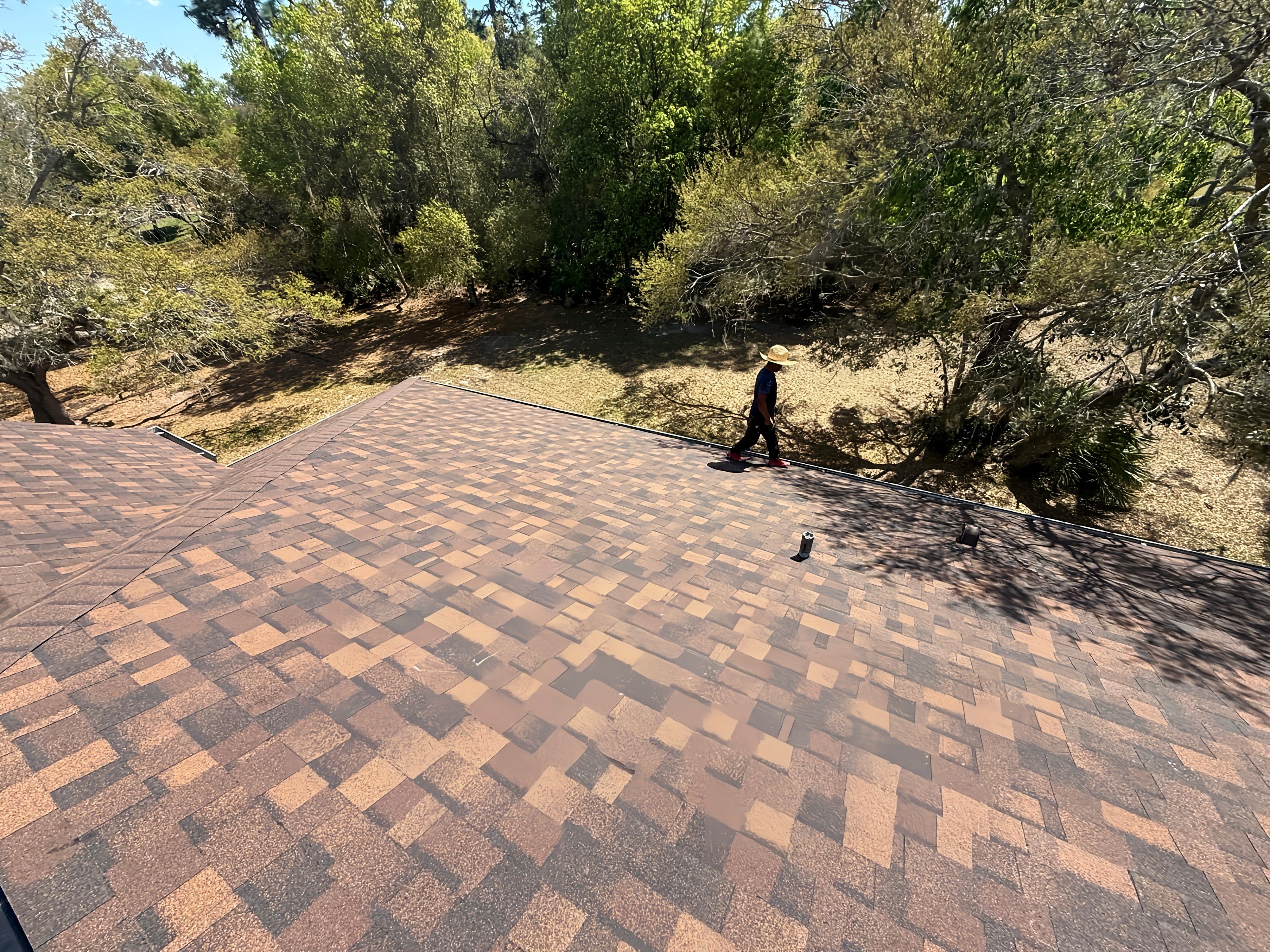
Two out of three Altamonte homes share walls
Altamonte Springs has more renters than owners and more shared buildings than detached houses. Census estimates for 2020 to 2024 put 22,821 housing units inside the city. Of the 20,871 occupied units, 43 percent are owner-occupied and 57 percent are rented.
Detached single-family houses make up only about 24 percent of all units. Another 11 percent are attached single-family homes, which is how the Census counts most townhomes. The remaining two thirds sit in buildings with two or more units, from duplexes to complexes of 50 units or more.
Owners lean toward detached houses, but only slightly. Of the 9,019 owner-occupied homes, about 51 percent are detached houses. Nearly all of the other half are townhomes or units in multi-unit buildings, and for most of those owners the roof decision runs through an association.
That changes how a roof job starts. On a detached house near Lake Orienta or Spring Lake, the owner calls a roofer and signs a contract. In a townhome row or a condo building, the first call often goes to a property manager, and the contract goes to the board.
When the board owns the roof
Every association writes its own rules, so read your declaration before you plan anything. In general terms, the setups below are the ones owners run into.
In many condominiums, the roof is a common element. The association decides when to replace it, picks the material, collects the money through reserves or a special assessment, and signs the contract. An owner with a leak reports it and waits for the association to act.
In many townhome communities, the owner holds title to the roof over their unit, but the association controls what it looks like. The owner pays, and the board approves the shingle, the color and sometimes the contractor. Because a townhome row usually has one continuous roof, the board often wants the whole building done at once so the shingles match and the seams over each firewall stay tight.
Some communities split the difference. The association replaces roofs on a schedule, and owners handle repairs between replacements.
Florida law adds a step for taller condo buildings. Under Florida Statute 718.112, a condominium building three habitable stories or higher needs a structural integrity reserve study at least every 10 years, and the roof is one of the items it must cover. That study puts a replacement year and a dollar figure in front of the board. One and two story condo buildings are excluded, and townhome associations that are not condominiums fall outside that section.
For a board, we inspect each building, photograph what we find and write a plan that can be phased across budget years. For an owner, we find the source of a leak and give you a photo report you can hand to the manager. If the water is coming through a wall or a neighbor's section, the report says so.
Roofs on houses from the 1970s and 1980s
Most of Altamonte was built in two decades. The ACS shows 62 percent of the city's housing units went up between 1970 and 1989, and the median year built is 1983. Fewer than 9 percent of units predate 1970, and fewer than 5 percent were built in 2010 or later.
That age profile tells you something about the roofs. Architectural shingles in Central Florida last about 15 to 22 years, as our roof lifespan guide explains. A house finished in 1983 has probably had its original roof replaced at least twice. The age of the house says little. The age of the current roof says a lot.
Older roofs in this group often carry problems that a newer one would not. Decking may have been patched over rather than replaced during an earlier re-roof. Plumbing vent boots and roof-to-wall flashing get reused more often than they should. On a 1970s house, the attic may have little ventilation, which cooks shingles from below. We check all of these during a free roof inspection and price any decking or flashing work before the job starts.
If you own a detached house, the roof's age also shows up on your insurance renewal. Our guides on wind mitigation inspections, the My Safe Florida Home program and Florida's 25 percent roof rule cover what an insurer looks at and what a new roof can change. Once a replacement is finished, a wind mitigation inspection follows at no cost, and we set it up.
The Little Wekiva River crest of 2022
The National Weather Service tracks the Little Wekiva River with a gauge near Altamonte Springs. Major flooding at that gauge starts at a stage of 29.5 feet.
On September 29, 2022, as Hurricane Ian crossed Central Florida, the river crested at 31.09 feet. That is the highest stage on the gauge's record, about half a foot above the previous high of 30.58 feet from November 1994. Two years later, during Hurricane Milton, the river reached 30.07 feet on October 10, 2024. Hurricane Irma pushed it to 29.66 feet in September 2017.
River water does not reach a roof. The rain that fills the river is a different matter. Storms that drop enough water to push the Little Wekiva past major flood stage also drive rain sideways for hours, and that is when lifted shingles, cracked pipe boots and tired valley flashing start to leak. If you live near the river and spent the days after Ian or Milton dealing with water on the floor, the roof may not have had a proper look.
After a storm, our storm damage guide lists what to photograph and when to call your insurer. With water dripping indoors, the tarp goes on and the photos get taken before anyone discusses repair or replacement.
Newburyport Avenue or the county office in Sanford
An Altamonte Springs mailing address does not always mean the city issues the permit. Inside city limits, the Building and Fire Safety department at 225 Newburyport Avenue handles it. Some 32714 addresses are in unincorporated Seminole County, where the county Building Division in Sanford issues permits and books inspections through its OneStop portal. We check the parcel before we file.
The city's process has a few details worth knowing. Licensed contractors can apply through the city's online self-service portal, but only for permits that need no plan review. The city recommends that anything needing plan review come in as a hard copy, or as PDFs on a USB drive. A homeowner pulling their own permit has to apply in person. Contractors schedule inspections through the same portal.
Both offices follow the same state rule on paperwork. Florida Statute 713.135 says that on a direct contract above $5,000, no inspection happens until the permit office has a copy of the recorded notice of commencement. Every roof replacement in our price range clears that line, so we record the notice and file the copy before the crew starts. Our Orlando and Orange County permit guide explains the notice of commencement in more detail.
Low-slope roofs on SR 436 and around Cranes Roost
Shopping centers, offices and restaurants line SR 436, and the mixed-use blocks of Uptown Altamonte surround Cranes Roost. Behind the parapets, most of those buildings are flat or nearly flat.
We install TPO and modified bitumen on those roofs, and flat roofing usually runs $7 to $13 per square foot. Price moves with insulation thickness, the number of drains and how hard it is to stage materials on a busy site. Leaks on these roofs tend to start where the membrane meets something else, such as a drain, a parapet, a scupper or an HVAC curb. We detail those first on a repair and rebuild them on a replacement.
For owners and managers of retail or office space, our commercial roofing page covers scheduling around tenants. We can work early, phase a large roof in sections and keep the building open. If you are a tenant with a leak, the lease usually puts the roof on the landlord, so send them our inspection report.
Sources
- U.S. Census Bureau, ACS 2020 to 2024 5-year estimates, Altamonte Springs city, Florida, tables B25003, B25024, B25032, B25034 and B25035 (via Census Reporter)
- NOAA National Water Prediction Service, Little Wekiva River near Altamonte Springs (LWAF1), flood categories and historic crests
- City of Altamonte Springs, Apply for Permits and Schedule Inspections
- Seminole County Building Division
- Florida Statutes 713.135, notice of commencement and permit applications
- Florida Statutes 718.112, condominium structural integrity reserve study