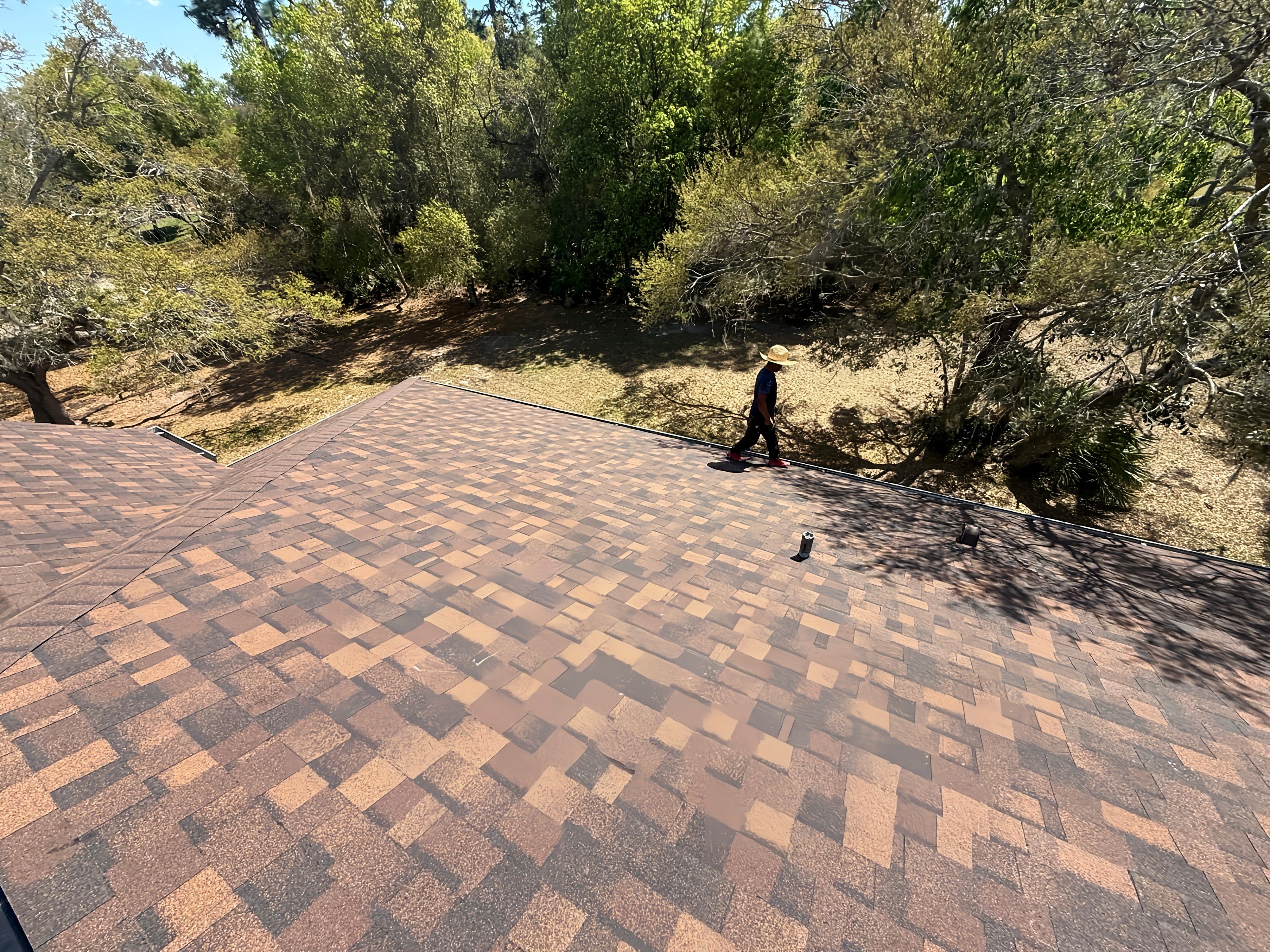
Roofs on the Winter Park Register
Winter Park keeps its own register of historic places. City staff maintain it, and it covers single buildings as well as whole districts and neighborhoods. Two districts sit on the local register, College Quarter and Virginia Heights East. Two more, Downtown Winter Park and Interlachen Avenue, carry National Register listings instead.
Only the city's own register brings a roof in front of the board. The city's Certificate of Review application says a review is required for work on designated landmarks, properties and districts, and that this work includes any exterior alteration. A new roof changes what the house looks like from the street. On a designated home we plan for review unless city staff tell us the work is exempt.
The Historic Preservation Board decides these applications. Its guide is the Secretary of the Interior's Standards for Rehabilitation. The board weighs the style, texture and materials of the proposed work against the house and the rest of the district. It does not review interior work.
The calendar is the part owners tend to underestimate. A complete application has to reach the city at least 24 days before the board meeting where it will be heard. The city mails a notice to every owner within 500 feet of the property. The board has 60 days from receipt to act, and its ruling can be appealed to the City Commission within 15 days.
The form asks for photos and material and product information. For a roof, that means photos of each elevation, the existing material, and the spec sheet and color of the proposed one. On a 1920s house with steep gables, a profile close to the original usually has the shortest path through review. The application also tells owners to talk with city staff before spending money on plans, and that call is our first step.
Homes that are not designated follow the normal permit path with no board review, even when they are old.
What the Census says about Winter Park houses
Winter Park has 14,213 housing units, by the Census Bureau's five-year estimates for 2020 to 2024. Its median year built is 1976. That middle year hides a city with two very different halves.
The single largest decade is the 1950s, with 2,621 homes, about 18 percent of the housing stock. Another 1,449 homes are older still, and 662 of those were built in 1939 or earlier. In total, about 29 percent of Winter Park homes predate 1960, and about 56 percent predate 1980. At the other end, 2,105 homes, roughly one in seven, were built in 2010 or later.
Owners live in 8,499 of the 12,846 occupied homes, about 66 percent. Those owner-occupied homes carry a median value of $731,400.
Here is what those numbers mean on a roof. Central Florida sun wears out a shingle roof in roughly 15 to 22 years, so a 1955 house that has always had shingles is probably on its third or fourth roof, and each earlier crew made its own choices about the decking. Some of these houses still have the original boards. Others got plywood over or in place of the boards on an earlier job. Nobody can know which until the old roof comes off, so the estimate calls out decking repair as its own line, and the photo report shows what we found.
The newer homes bring a different set of problems. Large two-story houses with tile or metal have long valleys, wall flashing and roof-to-wall joints that take more time to detail than a 1950s gable roof.
Oaks over the roof and the city's tree code
Winter Park's tree ordinance, Ordinance 3320-24, was adopted on October 17, 2024. It names keeping the city's Tree City USA recognition as one of its goals. Any tree at least six inches in diameter at breast height is protected. A live oak or bald cypress of 30 inches or more in fair to excellent condition is a landmark tree.
Two parts of the ordinance touch roofing. The first is pruning. Topping, lion's-tailing and over-lifting count as improper pruning, and doing that to a protected tree without a permit breaks the code. Hacking a big limb back to clear a roof can land an owner in trouble with the city.
The second is hazard trees. On an occupied residential lot, a tree that poses an unacceptable risk to people or property can come down without a permit. At the time of removal, the owner and the tree crew both need written findings from an arborist certified by the International Society of Arboriculture, or from a landscape architect licensed in Florida. Trees that already fell in a storm are exempt from the permit, except on city property or near shorelines and waterways, a real exception in a city built around lakes.
Oaks wear roofs in three ways we see on inspections. Limbs that touch the roof scrape granules off shingles every time the wind moves them. Leaves pack into valleys and gutters and hold water at the roof edge. Shade keeps north-facing slopes damp, and algae follows. Our inspection report notes which limbs are in contact with the roof. Pruning belongs to a certified arborist who knows the city's rules, and a re-roof goes best when that pruning happens first, so the new shingles start clean.
Two storms that tested Winter Park roofs
Hurricane Charley crossed Orange County on the night of August 13, 2004. The National Weather Service Melbourne radar timeline puts the storm over Winter Park at 9:22 pm. Orlando Executive Airport, the official station closest to the city, recorded a peak gust of 74 knots, about 85 mph. Orlando International Airport, farther south, recorded 91 knots, about 105 mph.
Twenty years after Charley, Milton brought a different test in October 2024. For Orange County, the NWS Melbourne county summary reports gusts of 55 to 75 mph, locally as high as 87 mph, and 4 to 8 inches of rain, locally up to 10. Countywide, the preliminary damage tally reached 188 structures, 32 of them with major damage and 79 with minor damage. County emergency managers logged downed trees and power lines scattered across Orange County. One of the county's five indirect deaths was a man who fell from his roof while clearing storm debris.
Under a canopy this dense, storm damage often comes from a limb strike or a branch sitting in a valley, more than from wind peeling shingles. After a storm, stay on the ground. Take photos of what you can see from the yard and call (407) 970-9746. We tarp active leaks first, then return for a full inspection with photos for your insurer. Our guide on what to do after roof storm damage walks through the claim, and our emergency tarping page covers the first visit.
How a Winter Park roof replacement gets approved
City of Winter Park Building & Permitting Services issues roof permits inside city limits. Applications, fees and inspection requests all go through the city's Permitting Self-Service Portal. A handful of Winter Park mailing addresses are actually unincorporated Orange County, and those permits go to the county. We confirm the jurisdiction from the parcel record before anything is filed. Our guide to roof permits in Orlando and Orange County explains the county side.
On a designated historic home, the Certificate of Review comes before the building permit. We build the board's meeting calendar into the start date so the wait for a board meeting is on the schedule from day one. We record the Notice of Commencement when the contract amount requires one and meet the inspector on site.
Repair or replacement on an older Winter Park roof
Many leaks on Winter Park's older houses start at a chimney, a valley under an oak, or a porch roof added decades after the house was built. Those repairs run $350 to $1,500, and bigger repairs $1,500 to $5,000. Replacing the whole roof costs $12,000 to $22,000 in architectural shingles, $26,000 to $48,000 in standing seam metal and $28,000 to $50,000 in concrete tile. Our roof replacement cost guide shows what moves a price within those ranges.
The free roof inspection comes with a photo report. If the roof has good years left, the report says so and we quote a roof repair. If the damage covers a large share of the roof, read our note on the Florida 25 percent roof rule and our repair vs replacement guide. Every roof replacement includes a free wind mitigation inspection you can send to your insurer.
Sources
- U.S. Census Bureau, ACS 2020 to 2024 5-year estimates, tables B25034, B25035, B25003 and B25077, Winter Park city, Florida (via Census Reporter)
- City of Winter Park, Historic Preservation (local register and National Register districts)
- City of Winter Park, Local Register Certificate of Review Application
- City of Winter Park, Ordinance 3320-24, tree preservation and protection (adopted October 17, 2024)
- National Weather Service Melbourne, Hurricane Charley survey and post tropical cyclone report (2004)
- National Weather Service Melbourne, County Impacts Associated with Milton (2024)