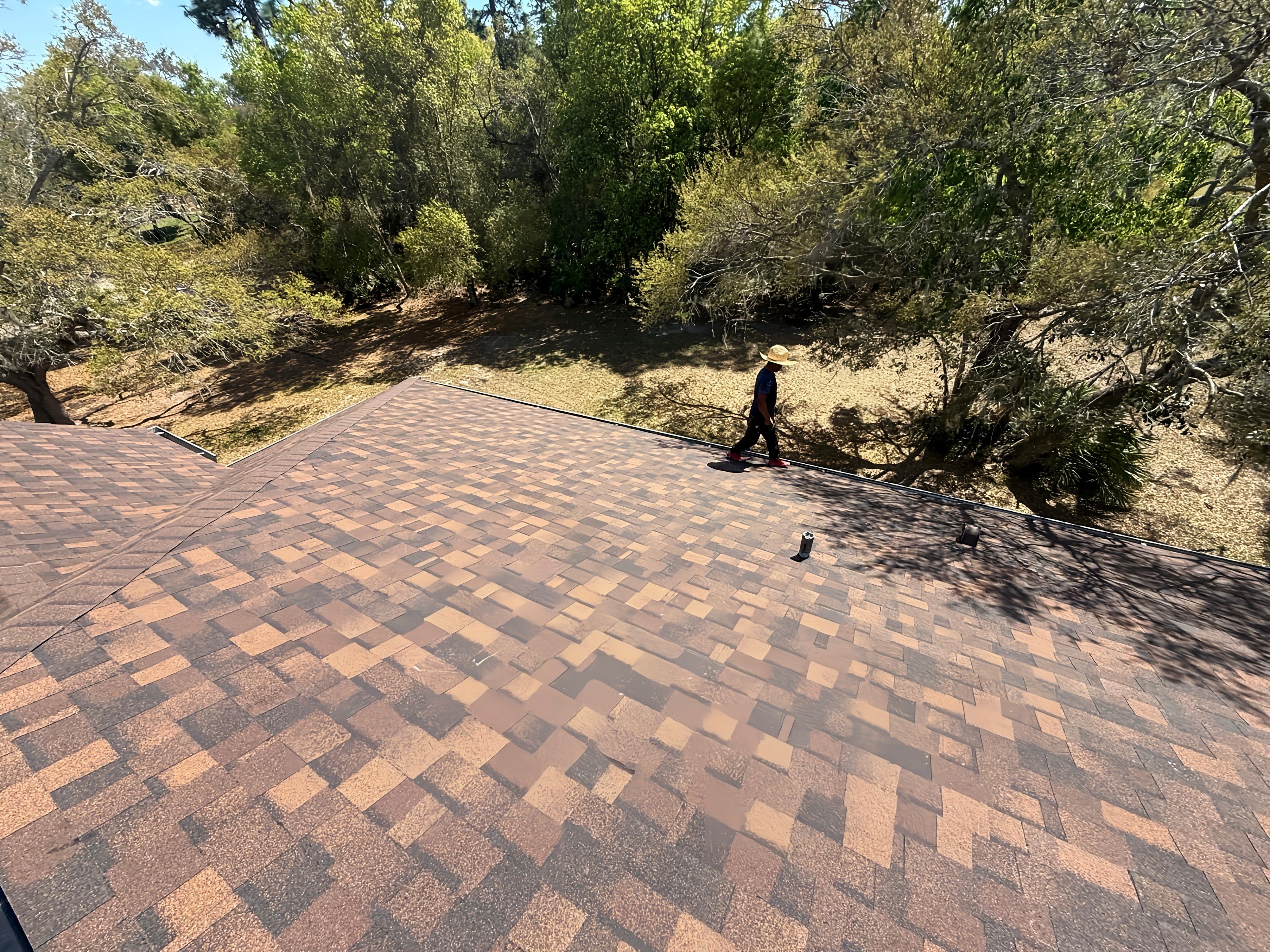
Most hurricane roof damage starts at a weak spot that was already there, such as a lifted shingle, a cracked tile, a loose piece of flashing or a rotten fascia board. Wind lifts the roof covering from there. Find and fix them before a storm is in the forecast.
Use this checklist in two passes. Do the first part before the season starts. Do the second part when a storm is in the forecast.
What should I do before hurricane season?
- Get a roof inspection. A roofer will catch problems you cannot see from the ground, like broken seal strips, cracked tiles, worn pipe boots and soft decking.
- Fix loose or missing shingles and tiles. One missing shingle can turn into a missing section in high wind.
- Check the flashing. Look at chimneys, walls, skylights and vents. Loose flashing lets wind-driven rain in.
- Replace worn pipe boots. Cracked rubber boots around plumbing vents are one of the most common leak sources we see.
- Clean gutters, downspouts and valleys. Water needs a clear path off the roof in heavy rain.
- Trim trees. Cut back branches that hang over the roof, and have an arborist look at any tree that could fall on the house.
- Check the soffit and fascia. Loose soffit panels can blow out and let rain into the attic.
- Look in the attic. Water stains, daylight or damp insulation mean a leak that should be fixed now.
- Know your roof-to-wall connections. A wind mitigation report shows whether your roof is held on by toenails, clips or straps (state form OIR-B1-1802). See our wind mitigation inspection guide.
A roof with only a season or two left is cheaper to replace in February than to patch in September. Read signs you need a new roof and how long a roof replacement takes.
What paperwork should I gather?
After a storm, a claim depends on what you can document. Gather these records now.
- Your policy and declarations page. Find the hurricane deductible and turn the percentage into dollars. On a $300,000 dwelling limit, a 2 percent deductible is $6,000 you pay before the policy pays (section 627.701, Florida Statutes). Our hurricane deductible guide explains the once-a-year rule.
- Before photos. Take clear photos of every roof slope, the gutters and the attic. Date them.
- Roof records. Keep your last roof permit, invoice, warranty and wind mitigation report together.
- Your insurer's claim phone number and app. Save them in your phone.
Pre-storm photos give an adjuster something to compare against. Florida's Homeowner Claims Bill of Rights also asks you to keep receipts for any work done after the storm.
What should I do when a storm is coming?
- Secure the yard. Hurricane wind can throw patio furniture, grills, planters and trampolines into the roof. Bring them in or tie them down.
- Clear the gutters one more time if it is safe to do from the ground or a stable ladder.
- Do not tarp an undamaged roof. A tarp can catch wind and pull up shingles.
- Do not go on the roof once wind picks up.
- Move valuables away from the ceiling in rooms under known weak spots.
- Charge your phone so you can document damage afterward.
Should I add hurricane straps or a new roof before the season?
For a tired roof, no checklist beats replacing it before June. When an older site-built house gets reroofed, state law has the crew fasten the deck with more nails and lay a secondary water barrier under the new covering (section 553.844, Florida Statutes). See Florida Building Code roof requirements. For help paying for upgrades, see the My Safe Florida Home program.
Compare options and costs in our shingle vs metal vs tile guide and our Orlando roof replacement cost guide.
What happens after the storm?
Wait for the wind to drop, then walk the yard and photograph the roof before anyone hauls debris away. Water coming through a ceiling calls for a tarp; ours usually cost $300 to $1,200. Florida gives you a year from the date of loss to open the claim (section 627.70132, Florida Statutes), but early reports are easier to prove. The rest of the sequence is in what to do after roof storm damage.
How do I get my roof checked before hurricane season?
Spring is the easy window. Schedule a free roof inspection between March and May and you get photos of every slope, the flashing and the attic, which double as your pre-storm record. Already have storm damage? Phone (407) 970-9746 and ask for a tarp.
Sources
- Florida Statutes s. 627.701, hurricane deductibles
- Florida Statutes s. 627.70132, notice of property insurance claims
- Florida Statutes s. 627.7142, Homeowner Claims Bill of Rights
- Florida Office of Insurance Regulation, Form OIR-B1-1802 (Rev. 04/26)
- Florida Statutes s. 553.844(3), reroof mitigation requirements