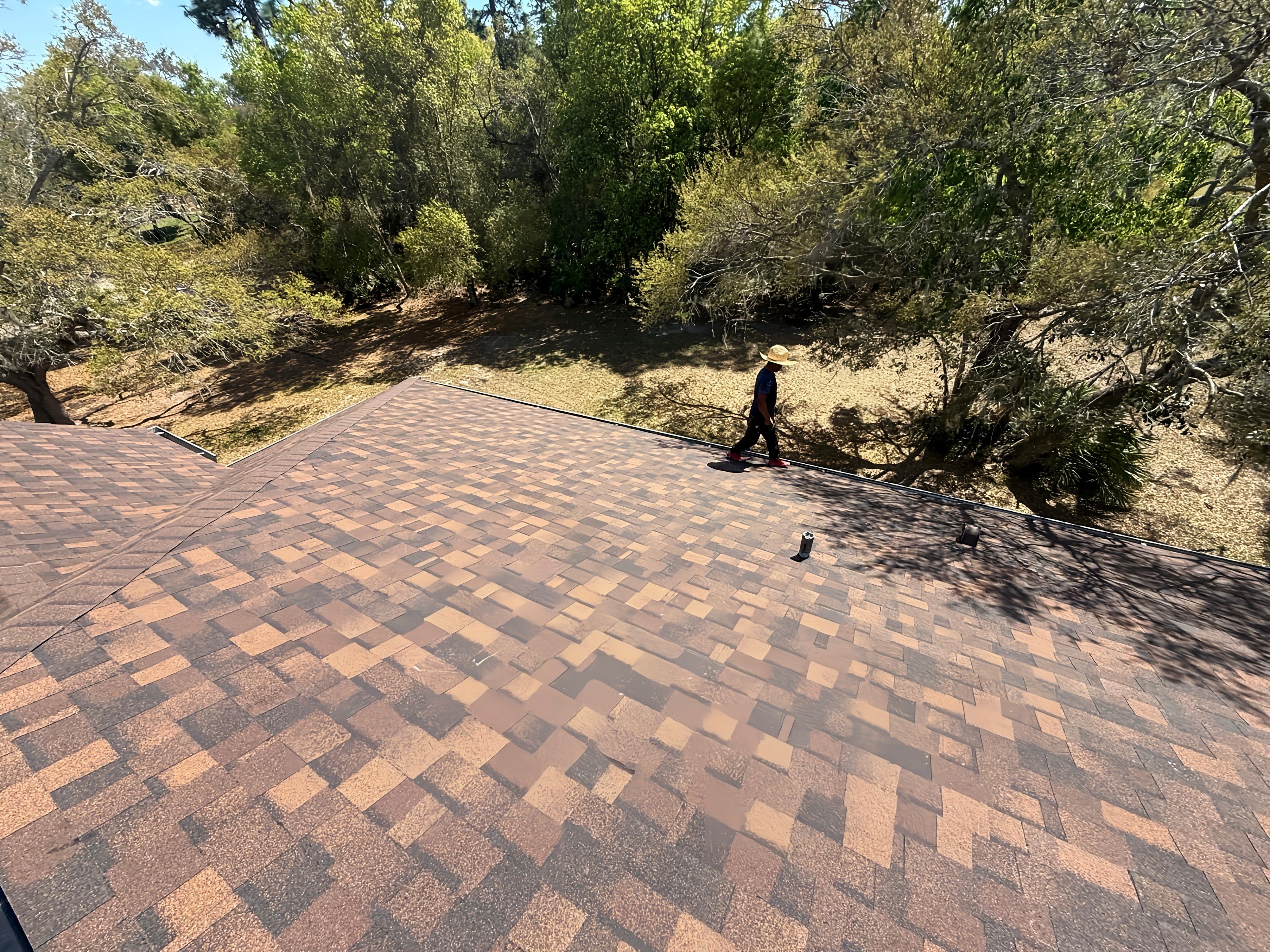
Most roofs show warning signs for months or years before they fail. Some signs call for a repair, and others mean it is time to plan a replacement. The table lists the ones we check on Orlando roofs.
| Sign | Where to look | What it usually means |
|---|---|---|
| Granules in gutters or at downspouts | Ground level | Shingles are wearing out |
| Curling, cupping or cracked shingles | From the yard, with binoculars | UV and heat aging, end of life near |
| Missing shingles after normal storms | Yard, roof edges | Seal strips are failing |
| Leaks in more than one spot | Ceilings, attic | The roof is failing as a system |
| Water stains or daylight in the attic | Attic | Active leaks or gaps |
| Soft or sagging areas | Roof lines from the street | Decking damage or rot |
| Cracked or slipped tiles, wet underlayment | Tile roofs | Underlayment near the end |
| Roof age of 18 years or more (shingle) | Permit records | Plan for replacement |
What does granule loss mean?
Shingles are coated in mineral granules that protect the asphalt from the sun. As shingles age, the granules wash off. If you see dark sand collecting at your downspouts or in gutters, or bare, shiny patches on the roof, the shingles are losing their protection. Florida UV speeds that up.
Why do curling or cracked shingles matter?
Curling and cracking mean the asphalt has dried out. Curled edges catch wind, and cracked shingles let water reach the underlayment. A few curled shingles can be replaced. Curling across every slope means the whole roof is wearing out at once.
What if shingles keep blowing off?
If shingles come off in normal summer storms, without a hurricane, that is a sign the seal strips have failed across the roof (IBHS research on aged shingles in the 2020 Midwest derecho). Each storm after that peels a loose shingle back a little more, until it tears off.
Why are leaks in different places a bad sign?
A single leak usually has a single cause, like a cracked pipe boot or loose flashing. That is a repair. When leaks show up in new places after each repair, the roof is failing as a whole. Our roof leak guide covers what to do right away.
What should I look for in the attic?
Go up on a dry, bright day with a flashlight. Look for:
- Water stains on the underside of the roof deck or on rafters
- Daylight coming through the boards
- Damp or matted insulation
- Dark spots or mold around nails
Also notice how hot and stuffy it feels. Poor ventilation heats shingles from the attic side (Florida Solar Energy Center attic ventilation review) and is one of the most common reasons we see roofs wear out early.
Does a sagging roof mean I need a new one?
Usually it means the decking or framing has a problem, often from long-term moisture. Soft spots feel spongy underfoot, which is one more reason not to walk your own roof. Decking damage can be repaired in small areas, but widespread rot points to replacement.
How old is too old for a Florida roof?
Count from the year the roof went on. On Orlando houses we see architectural shingle roofs reach 15 to 22 years, standing seam metal 40 to 60, and concrete tile 30 to 50, with the felt under the tile due at about 20 to 25. Full details are in how long does a roof last in Florida.
Your insurer counts age too, and it starts the clock at the last time the entire roof was built or replaced, per section 627.7011, Florida Statutes. A partial reroof does not reset it. That statute also gives roofs 15 and older a chance to pass an inspection before a forced replacement; our roof age insurance guide covers how.
Does the age of my roof affect storm repairs?
It can. If your roof went on before the 2007 code, big storm repairs can trigger the 25 percent rule and turn into a full reroof. A roof installed to that code or later only needs the repaired area brought current, under section 553.844(5), Florida Statutes. The 25% roof rule guide shows how to tell which side your roof falls on.
I see some of these signs. What now?
Take time to decide, and turn down anyone who pushes for a same-day signature. Some of these signs call for a repair that can keep the roof going for years. Others mean it is time to plan a replacement. Read repair vs replacement to think it through, and check prices in our Orlando roof replacement cost guide.
If you counted two or more signs on the list, a free roof inspection is the next step. We check both the roof surface and the attic, then give you photos and our estimate of the years left. Roofs we replace or repair also get a free check-up every year afterward.
Sources
- Florida Statutes s. 627.7011(5), roof age and homeowners insurance
- Florida Statutes s. 553.844(5), roofs built to the 2007 Florida Building Code or later
- Florida Solar Energy Center, Literature Review of the Impact and Need for Attic Ventilation in Florida Homes (FSEC-CR-1496-05)
- IBHS, performance of asphalt shingle roofs in the 2020 Midwest derecho, Cedar Rapids, Iowa (July 2023)