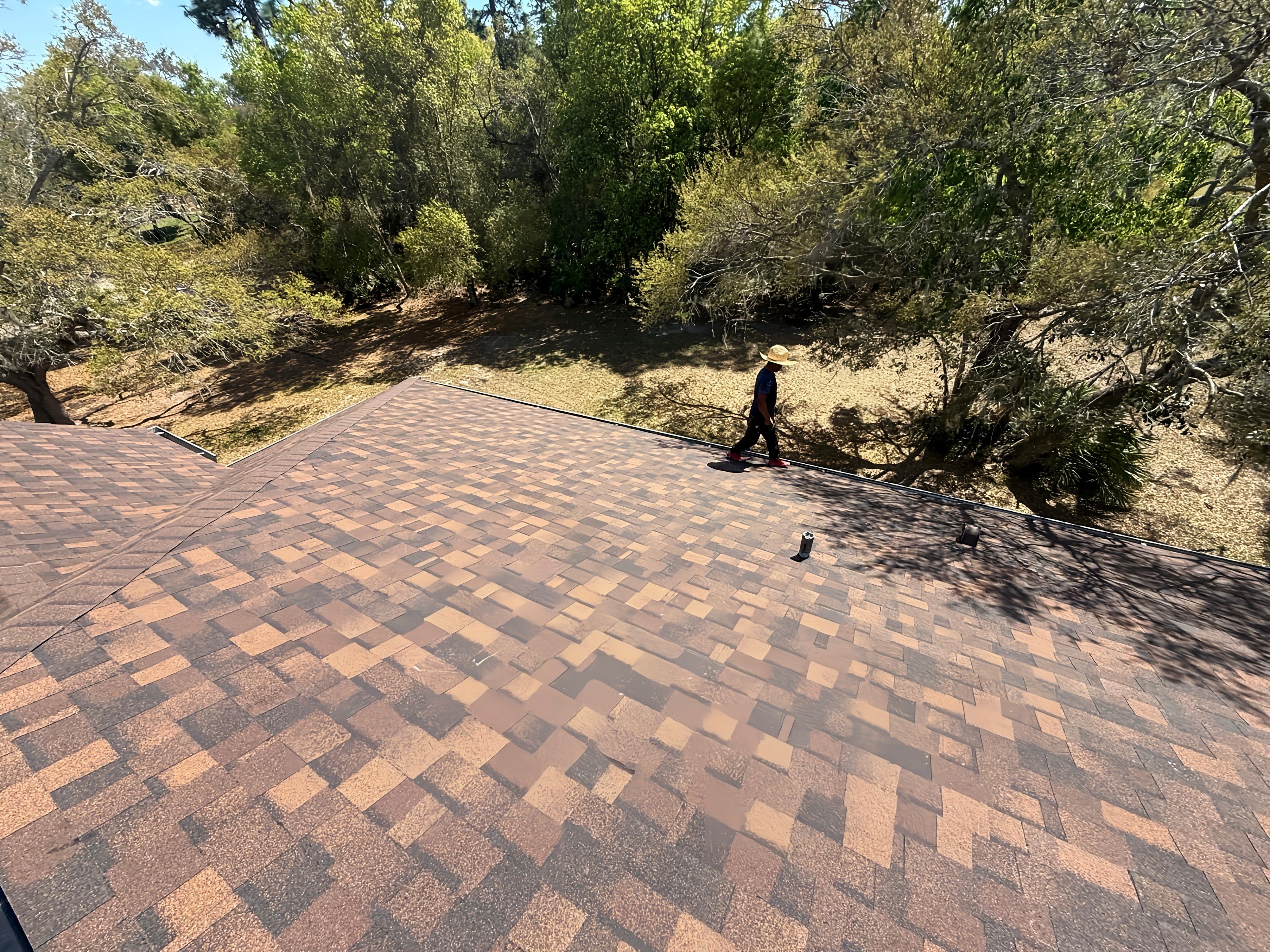
Six rules from the Florida Building Code and Florida Statutes shape a reroof in Orlando. Use the table to check whether a bid includes the ones that apply to your home.
| Requirement | What it means for your reroof |
|---|---|
| Roof deck attachment | Deck fastening is checked and strengthened where the covering is removed |
| Secondary water barrier | A sealed layer under the roof covering to keep water out if the covering is lost |
| Product approval | Roofing products must be approved for use in Florida |
| 25% rule | Large repairs on roofs permitted before the 2007 code took effect can trigger full replacement of the roof or section |
| Roof-to-wall connections | Required on reroofs only for certain higher-value homes in wind-borne debris regions |
| HVHZ rules | Apply only in Miami-Dade and Broward. Not in Orlando |
Why does Florida require extra work on a reroof?
Florida law directs the Florida Building Commission to develop hurricane mitigation techniques for older homes. Section 553.844 of the Florida Statutes now requires that roof replacements on site-built single-family homes include roof deck attachment and secondary water barrier techniques. A reroof is the one time the deck is exposed, so it is the cheapest time to strengthen it.
What is roof deck re-nailing?
Your roof deck is the plywood or OSB sheathing under the shingles or tile. In older Florida homes, it was often attached with fewer or smaller nails than current code calls for. In high wind, suction can peel those sheets off. Rain then pours into the house through the open roof.
The code requires the deck attachment to be strengthened and corrected wherever the roof covering is removed. The Florida Building Commission's retrofit provisions call for supplemental 8d ring-shank nails where the existing fastening falls short. Ring-shank nails grip the wood far better than smooth nails.
You cannot see this work once the roof is on, so check that the written scope lists it.
What is a secondary water barrier?
It is a backup layer that keeps rain out if wind strips the roof covering. Standard underlayment alone does not count. The Florida Building Commission's retrofit provisions have listed options such as:
- Taped deck seams. A strip of self-adhering polymer-modified bitumen tape over every joint in the deck, with approved underlayment on top.
- Full self-adhered membrane. A self-adhering membrane covering the entire deck.
- Reinforced synthetic underlayment with approved specifications, cap fasteners and sealed seams.
- Closed-cell spray adhesive applied to the attic side of the deck joints.
The exact options and specifications depend on the code edition in effect when your permit is issued. A sealed roof deck is also a category on the Florida wind mitigation form, so it can help your insurance. See our wind mitigation inspection guide.
Do roofing products need Florida approval?
Yes. Roofing is one of the product types Florida makes manufacturers get approved before anyone can install them (section 553.842, Florida Statutes). Once a product has statewide approval, it must be installed within the conditions of that approval. That is why your roofer's fastening pattern and underlayment choice should match the product's approval documents.
Do I need hurricane straps when I reroof?
Not always. Florida law requires roof-to-wall connection upgrades during a reroof only for certain higher-value homes in wind-borne debris regions. Section 553.844 applies it to homes in the wind-borne debris region with an insured value of $300,000 or more, or a just value of $300,000 or more if uninsured. The connections are not required unless they can be done for about 15 percent of the cost of the roof replacement. Ask your roofer whether your home qualifies.
What is the 25% rule?
It is the code's cap on patching an existing roof. Past a quarter of the roof or a section in a year, the whole thing gets redone to current code (see the text in Florida Building Commission staff analysis DS-2021-007). Roofs permitted under the 2007 code or a later edition have an exemption. Our 25% roof rule guide explains both, with an example.
What is the High-Velocity Hurricane Zone, and does it apply in Orlando?
The High-Velocity Hurricane Zone, or HVHZ, is a set of stricter roofing and structural provisions in the Florida Building Code. The code defines the zone as Broward and Miami-Dade counties only (Florida Building Commission 2023 roofing code comments).
Orlando and the rest of Orange County are outside the HVHZ, so roofs here follow the statewide provisions. Deck attachment, secondary water barriers and product approvals all still apply. Only the HVHZ-specific requirements do not apply. If a contractor says your Orlando roof must meet HVHZ standards, ask them to show you the code section.
How do I know my roof was built to code?
Look for a finaled permit on your last reroof. See roof permits in Orlando and Orange County. Compare bids with these items in mind, using our shingle vs metal vs tile guide and Orlando roof replacement cost guide.
Book a free roof inspection and we will show you how your current deck is fastened and what a code-compliant reroof would include. See our roof replacement service.
Sources
- Florida Statutes s. 553.844, windstorm loss mitigation and roof requirements
- Florida Building Commission, Hurricane Mitigation Retrofits for Existing Site-Built Single Family Residential Structures
- Florida Building Commission, 2023 code development roofing comments, HVHZ definition
- Florida Building Commission staff analysis DS-2021-007, text of FBC Existing Building 706.1.1
- Florida Statutes s. 553.842, statewide product approval