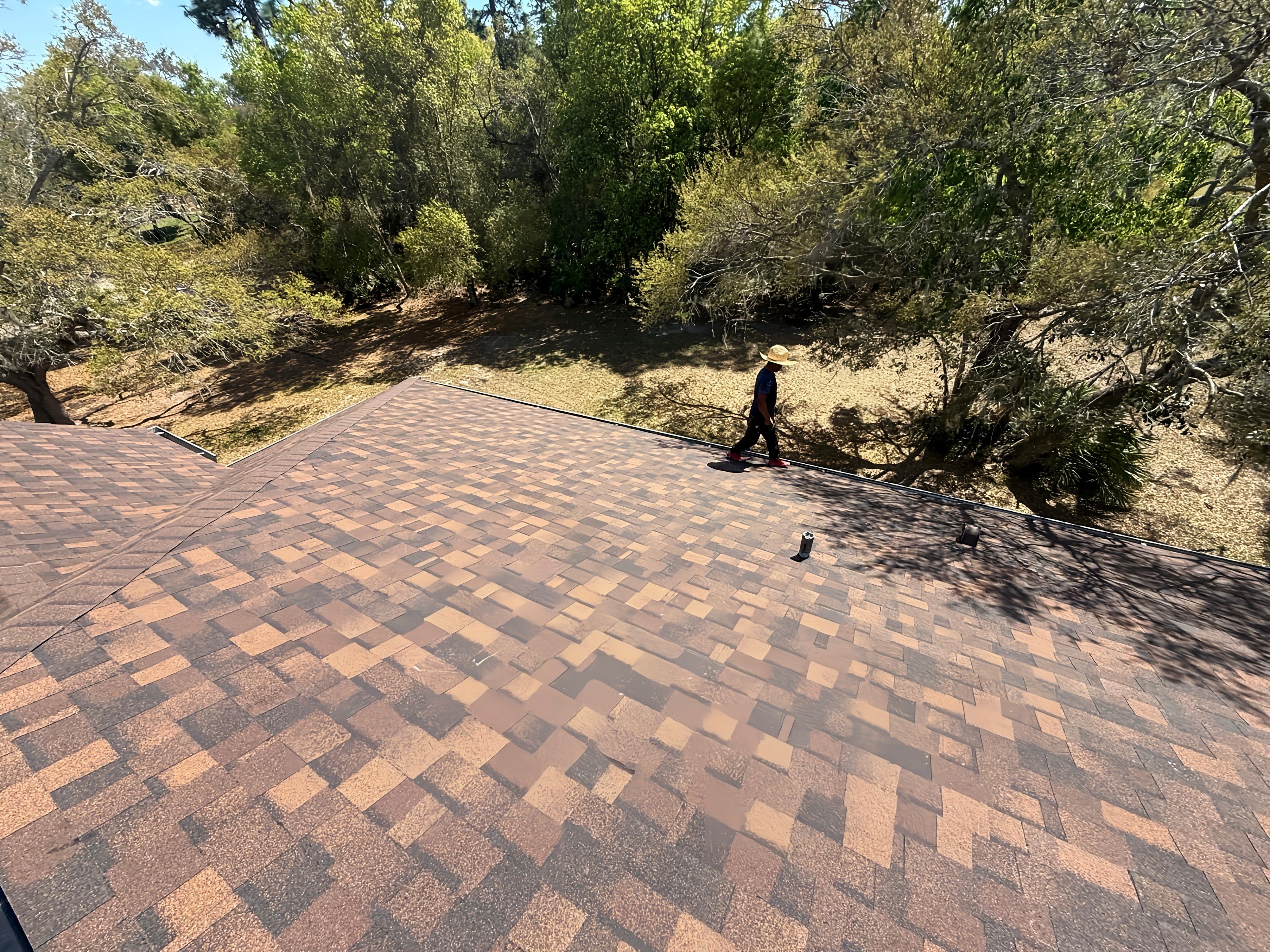
Three different promises can apply to a roof after a hurricane, and each one covers a different kind of failure.
| Coverage | Who gives it | What it pays for | What it leaves out |
|---|---|---|---|
| Manufacturer material warranty | Shingle maker | Manufacturing defects in the shingles | Storm damage, installation errors, flashing, decking |
| Manufacturer wind warranty | Shingle maker | Blow-offs up to a stated wind speed, for a set period | Winds or gusts above the limit, hail, falling objects |
| Workmanship warranty | Your roofing contractor | Installation errors | Weather beyond what a correct install can resist |
| Homeowners insurance | Your insurer | Sudden wind and storm damage, after the deductible | Wear and age, and anything your policy excludes |
What does a shingle wind warranty cover?
We use Owens Corning's documents as the example because they are public and detailed. Other manufacturers write their own terms, so read the warranty for the shingle on your roof.
Under the Owens Corning standard limited lifetime warranty, wind coverage starts only after the shingles thermally seal. That bond forms only after a few days of warm, direct sun on the sealant strip. Before that, Owens Corning says blow-offs are not a manufacturing defect and are not covered. After sealing, the shingles are covered for blow-offs or wind damage in winds, including gusts, up to the warranted speed, for the wind warranty period.
The remedy is narrow. The warranty caps Owens Corning's liability during the wind warranty period at the reasonable cost of hand sealing all the shingles on the roof. It does not pay for damage to your home or belongings caused by blown-off shingles.
What wind speeds do Owens Corning shingles carry?
The warranty table in the August 2026 document lists these limits. The wind warranty period is separate from the "limited lifetime" defect coverage.
| Shingle line | Standard wind warranty | Enhanced wind warranty | Wind warranty period |
|---|---|---|---|
| Oakridge | 110 mph (130 mph with 6 nails and starter at eaves and rakes) | Not offered | 15 years |
| Duration Series | 130 mph | 160 mph | 15 years |
| Woodcrest and Woodmoor | 130 mph | Not offered | 15 years |
| Supreme | 60 mph | Not offered | 5 years |
The 160 mph Duration figure requires a specific component package. The roof needs Duration Series shingles, Owens Corning starter on the eaves and rakes, Owens Corning hip and ridge shingles, a qualifying Owens Corning underlayment, and either an Owens Corning self-adhered ice and water barrier or VentSure vents. It also requires strict adherence to the enhanced wind application instructions. Miss any of that and the standard 130 mph limit applies.
What happens when hurricane winds beat the rating?
The warranty stops. Owens Corning treats the shingles as exposed to winds above the limit if the National Weather Service or another reputable weather agency records winds or gusts above that speed in your county, regional district or municipality. No wind warranty applies above that point.
The exclusions list closes other doors. It names hail, strong storms or winds over the maximum speed, damage from objects such as tree branches falling on the roof, and blow-offs caused by failure of the underlying roof deck. Improper installation is also excluded, which is where a workmanship warranty matters.
Is a wind rating the same as a wind warranty?
No. A 2023 Owens Corning technical bulletin on wind classifications explains that its full asphalt shingle line tests at D3161 Class F under the fan test and D7158 Class H under the uplift test. Under the International Residential Code and International Building Code, those classifications apply where the basic wind speed (Vasd) is up to 150 mph. The bulletin adds that codes reference the classification, not the warranty. A shingle can meet code where its warranted speed is lower than the code wind speed.
So a 130 mph warranty does not mean the shingle fails at 131 mph. It means the manufacturer stops paying above that speed.
Does a workmanship warranty help after a storm?
It helps when the cause is the installation. Shingles that lift because they were high-nailed, flashing that was never sealed, or a missing starter course are workmanship problems. A manufacturer excludes those, and an insurer may argue they are not storm damage.
Workmanship terms are set by each contractor, so get the length, what it covers and what voids it in writing before you sign. Our warranty page explains how we handle ours.
Where does homeowners insurance fit?
Sudden wind damage from a hurricane is the kind of loss a homeowners policy is written for. The hurricane deductible is the catch. Under Florida Statutes section 627.701, the insurer has to offer a menu of hurricane deductibles before it writes your policy, and the one you pick comes off the claim once per calendar year. Our hurricane deductible guide shows the options and a worked example.
On a $400,000 dwelling limit, a 2 percent hurricane deductible is $8,000. A roof repair under that amount comes out of your pocket. See does homeowners insurance cover roof replacement and what to do after storm damage for the claim steps.
What should I do with my warranty paperwork?
Keep the proof of purchase, the installation date and the registration confirmation together. After a storm, photograph the roof before anyone touches it, then call your insurer and, if you suspect a defect, the manufacturer. Owens Corning requires a claim within 30 days of discovering a problem, and disputes under that warranty go to arbitration where the law allows it.
If you sell the house, the buyer has 60 days after closing to register the transfer with Owens Corning. Our roof inspection for a home sale guide covers that step, and the hurricane roof preparation checklist covers what to do before the next storm.
To find out what your current roof is installed with and what its warranty still covers, book a free roof inspection.