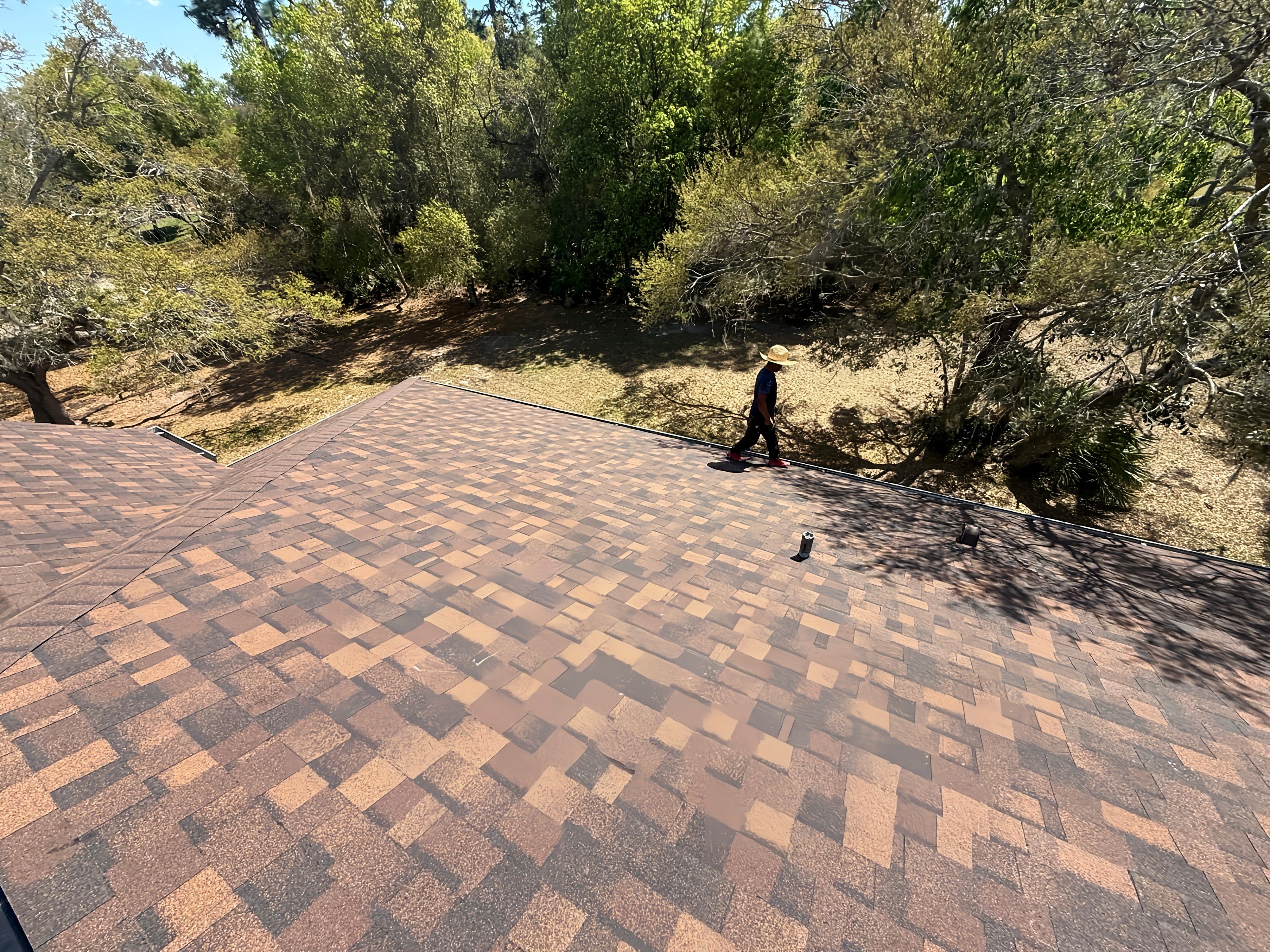
Crews cannot tear off a roof in the rain, and Orlando's rain follows a clear calendar. Here is what the numbers show and how to use them.
How much does it rain each month in Orlando?
Orlando's weather station has 30 years of monthly averages, 1991 to 2020, kept by the National Weather Service in Melbourne. The Orlando June climate normals sheet and its eleven companion sheets give these totals.
| Month | Normal rainfall | Hurricane season |
|---|---|---|
| January | 2.48 in | No |
| February | 2.04 in | No |
| March | 3.03 in | No |
| April | 2.58 in | No |
| May | 4.02 in | No |
| June | 8.05 in | Yes |
| July | 7.46 in | Yes |
| August | 7.69 in | Yes |
| September | 6.37 in | Yes, peak |
| October | 3.46 in | Yes |
| November | 1.79 in | Yes, final month |
| December | 2.48 in | No |
| Year | 51.45 in |
June through September brings 29.57 inches, about 57 percent of the year's rain. November through April adds up to 14.40 inches, about 28 percent, across twice as many months.
How do Orlando's seasons compare?
The same NWS sheets group the normals into three-month seasons. Summer carries more rain than winter and spring combined.
| Season | Months | Normal rainfall |
|---|---|---|
| Winter | December, January, February | 7.00 in |
| Spring | March, April, May | 9.63 in |
| Summer | June, July, August | 23.20 in |
| Fall | September, October, November | 11.62 in |
Fall looks mid-range on paper, but 9.83 of its 11.62 inches fall in September and October. By November the monthly normal drops to 1.79 inches, the lowest of the year. That makes November a strong month to start a project, as long as you accept that it is still officially hurricane season.
When do Orlando's wet and dry seasons start?
The NWS Melbourne office tracks the start of each season. In its record for Orlando, which runs from 1950, the median start of the wet season is May 27 and the dry season begins October 15. Median means half of years start earlier and half later.
That makes late October through mid-May the practical dry window. May is a transition month. It averages 4.02 inches, and the wet season often arrives before it ends.
How does hurricane season affect roof timing?
The National Hurricane Center's climatology gives the Atlantic hurricane season as June 1 to November 30. It puts the peak on September 10, with most activity between mid-August and mid-October.
For scheduling, a roof replaced in winter or spring is finished before the season opens.
Is your roof already showing its age? Have it looked at before June 1. Our hurricane roof preparation checklist covers what to fix ahead of the season.
Is winter ever too cold for shingles?
Orlando winters are mild. The January normals for Orlando show an average high of 71.8 degrees F and an average low of 49.5 degrees F.
Shingles still need warm sun to seal. The Owens Corning standard shingle warranty says the sealant strip under each shingle bonds only after several days of direct, warm sun. Shingles installed in cool weather may not seal until the weather warms, and Owens Corning does not cover blow-offs that happen before sealing. A week of cloudy, cool weather after installation slows that bond. It is a reason to watch the forecast, not a reason to avoid winter.
Does the season change the price?
The calendar is not a line item. What sets a quote is the roof's size and pitch, the material, and how much rotted plywood turns up after tear-off. A shingle roof in February starts from the same $12,000 to $22,000 range as one in July. The Orlando roof replacement cost page lists metal and tile too, and spells out the house size and scope behind each range.
How far ahead should I book?
Count back from the date you want the roof finished. The permit, the material order and the inspections all come before and after the days on the roof. Our guides on how long a roof replacement takes and roof permits in Orlando and Orange County lay out each step.
A good plan is to get an inspection and quote in late summer or early fall, then schedule installation for November through April.
When should I not wait for the dry season?
Replace or repair now if the roof is actively leaking, the decking is soft, or your insurer has sent a notice about the roof's age or condition. Waiting for drier weather while water gets in costs more than a rain delay. Our signs you need a new roof and roof repair vs replacement guides help you decide how urgent it is.
Book a free roof inspection now to lock in a dry-season start for your roof replacement.
Sources
- National Weather Service Melbourne, Orlando monthly climate normals (1991 to 2020), January sheet
- National Weather Service Melbourne, Orlando monthly climate normals (1991 to 2020), June sheet
- National Weather Service Melbourne, start of the wet and dry seasons
- National Hurricane Center, tropical cyclone climatology
- Owens Corning Standard Product Limited Lifetime Warranty, Pub. No. 10023873-I (August 2026)