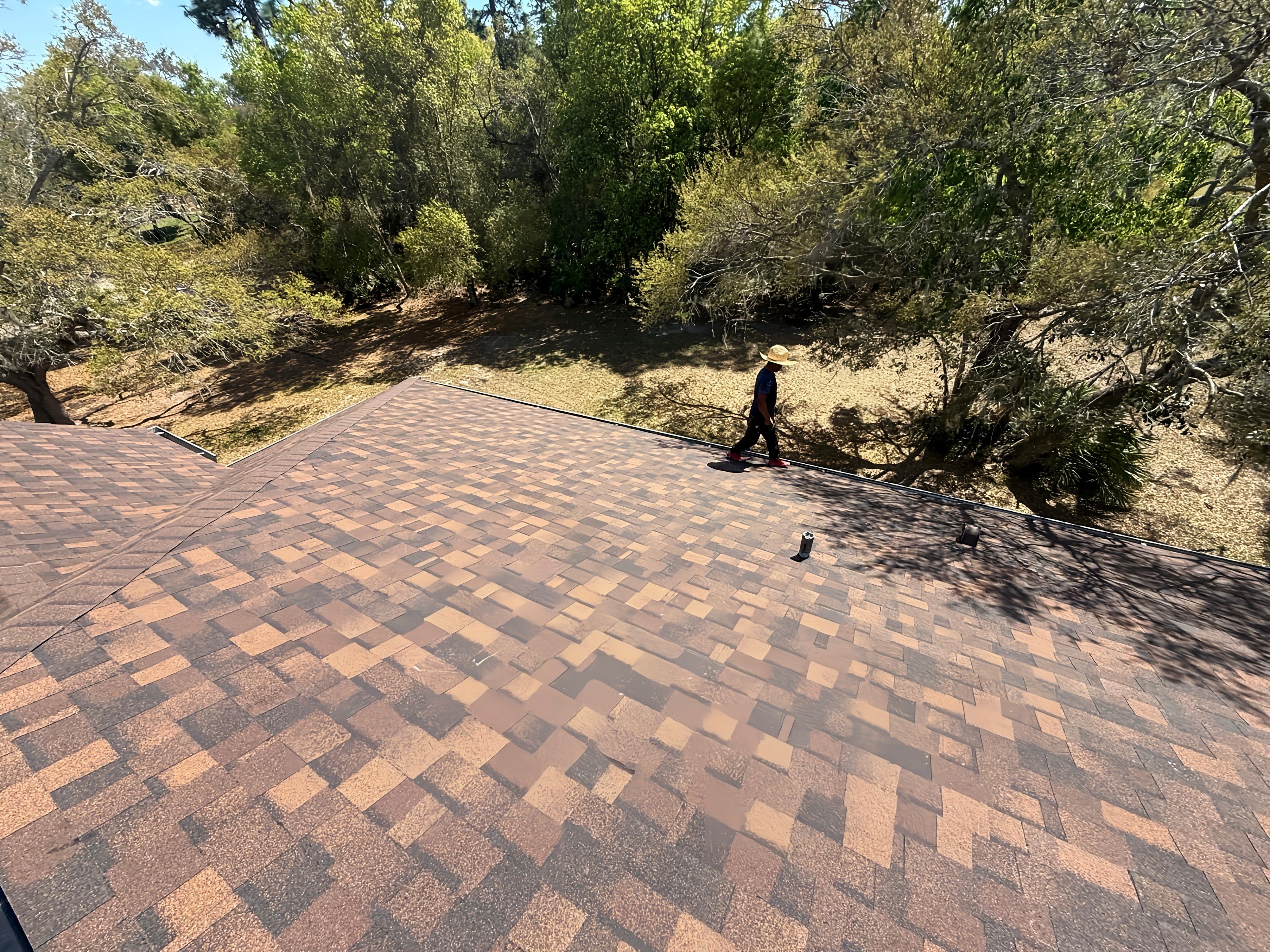
Wind and hail leave different marks. Wind pulls roofing up and off, so the damage follows edges and lines. Hail strikes from above, so the damage is scattered impacts. The National Weather Service calls a thunderstorm severe when it produces gusts of 58 mph or more or hail at least 1 inch across, about the size of a quarter.
| What you see | Wind damage | Hail damage |
|---|---|---|
| Pattern | Along eaves, rakes, hips and ridges, often in runs | Random across the slope |
| Shingles | Missing, lifted, creased or torn loose | Soft bruises, round spots of lost granules, cracks |
| Metal | Lifted panel edges, loose trim or fasteners | Dents, mostly on soft metal |
| Around the house | Shingles, tiles and limbs in the yard | Dented gutters and vents, spatter marks on metal |
What does wind damage look like on a roof?
On a shingle roof, wind works on the seal. Each shingle has an adhesive strip that bonds it to the course below. IBHS explains that wind can lift unsealed shingles and let water seep underneath. Its 10-year roof aging study found that unsealing remains the single greatest driver of shingle wind vulnerability, and that most products start losing wind resistance between years five and 10.
What we look for after a windstorm:
- Missing shingles, with bare underlayment or a lighter stripe where the shingle used to be
- Lifted tabs that stand up or flap, which means the seal strip let go
- Creased shingles, with a line across the top where the shingle folded back in the wind
- Exposed underlayment or decking at the eaves, rakes or ridge
- Missing ridge caps or ridge vents, which leave an open slot along the peak
- Slipped, cracked or missing tiles, often along the edges of a tile roof
- Lifted metal panel edges, loose trim or backed-out fasteners on a metal roof
FEMA's Hurricane Michael recovery advisory is a good picture of how this plays out in Florida. It noted widespread poor wind performance of asphalt shingles and linked failures to unsealed or partly unsealed shingles and to nails in the wrong spot. It also described a home whose ceilings collapsed from water after the only roof damage was lost ridge shingles and ridge vents. Small wind damage at the ridge can still let in a lot of rain.
How is hail damage different from wind damage?
Hail leaves impact marks, not torn edges. The IBHS hail damage brochure makes four points worth knowing.
- Real hail damage occurs in a random pattern.
- A bruise from a real hail impact can usually be felt by hand on the shingle.
- Ridge caps are among the most hail-vulnerable parts of a shingle roof.
- Spatter marks or dents on other things around the house are good signs that hail fell.
IBHS also lists look-alikes that are not hail. These include granule loss along shingle edges, blisters, marks from installation or foot traffic, and manufacturer defects. On metal, spatter is where hail knocked dirt or oxidation off a surface. It shows hail fell, but spatter alone is not damage.
Check aluminum gutters, downspouts and roof vents. Fresh dents or spatter on them tell you hail fell on the house, so the roof deserves a close look.
What can I check safely from the ground?
Stay off the roof. You can learn a lot from the yard and the attic.
- Walk all four sides. Look for shingles, tile pieces, ridge vent sections or metal trim on the ground. Note which side of the house they landed on.
- Scan the roof lines with binoculars. Look along the eaves, rakes, hips and ridge for gaps, lifted edges or a broken line of ridge caps.
- Check the soft metals. Fresh dents in gutters, downspouts and vents point to hail.
- Look at the downspout outlets. A fresh pile of granules right after a storm is worth a photo.
- Check the attic on a dry day. Look for new wet spots on the decking, damp insulation or light along the ridge.
If something looks off, or you simply cannot see the whole roof, have a roofer go up. Our signs you need a new roof guide covers wear that has nothing to do with storms.
How should I photograph storm damage for a claim?
Florida's Homeowner Claims Bill of Rights tells you to photograph or video the damage before and after any repair, make and document emergency repairs, and keep all receipts. The Department of Financial Services adds that you should keep damaged items for the adjuster if it is safe, and be able to give the adjuster the exact date the damage occurred.
A photo set that holds up:
- Wide shots first. Photograph each side of the house with the roof in frame, then move in closer on each problem.
- Debris where it landed. Shoot shingles, tiles and vent pieces on the ground before you pick them up. Then keep them.
- A size reference for hail. Put a coin or tape measure next to dents on gutters and vents.
- Inside damage. Ceiling stains, wet insulation and drips, with a wide shot that shows which room.
- The original files. Phone photos store the date and time. Send the originals, not screenshots.
- Before and after a tarp. Photograph the opening, then the tarp in place.
Write down the date of the storm. Under Florida Statutes s. 627.70132, a hailstorm or windstorm's date of loss is the day NOAA, the federal weather agency, verified it. Notice of a new claim is due within 1 year after that date. For the full step-by-step after a storm, see what to do after roof storm damage.
Which deductible applies to wind or hail damage?
That depends on the storm. The Department of Financial Services explains that the hurricane deductible covers a set window tied to hurricane warnings in Florida. Hail that falls from a hurricane's bands inside that window counts as hurricane damage. Damage from other causes falls under the all other perils deductible. Our Florida hurricane deductible guide walks through the math.
What should I do next?
Water dripping inside? Our emergency tarping service is the first call, at (407) 970-9746. When the roof is holding, a free roof inspection is the next step. We climb up, mark bruises and creases slope by slope, and give you a dated photo report that separates hail, wind and plain age. Learn more about our storm damage repair service.
Sources
- National Weather Service Birmingham, what constitutes a severe thunderstorm
- FEMA, Hurricane Michael in Florida recovery advisory, best practices for minimizing wind and water infiltration damage
- IBHS, Roof 101
- IBHS news release, asphalt shingle wind performance after 10 years of aging (September 2026)
- IBHS, Is It Hail Damage? brochure
- Florida Department of Financial Services, hurricane recovery resources
- Florida Department of Financial Services, Florida's hurricane deductible
- Florida Statutes s. 627.70132, notice of property insurance claims
- Florida Statutes s. 627.7142, Homeowner Claims Bill of Rights